Building with promises
Most apps ask you to trust them after the fact. You download, you sign up, you hand over your data, and somewhere in the settings a privacy policy does its best to explain what happens next. We’re building FastingBestie the other way around: we write down the promises first, and then we build to keep them.
What a promise looks like in our world
For us, a promise is a short sentence a reasonable person could hold us to, written in plain English rather than legal language. It sits next to the feature it governs. Sometimes that’s a design doc, sometimes a pull request, sometimes a comment directly above the code.
The one we’ve been circling this month:
If we ask for something, we’ll use it for good.
It reads like a truism until you notice how often an app asks you for things. Cycle dates. HealthKit permissions. A notification token. A weight. A meal. Each one is a small act of trust from you, and the promise is our side of that trade: whatever you give us exists to make your experience better, and nothing else.
Why we put it in writing
Writing a promise down changes how we build. When an engineer adds a new permission request, code review includes “does this still fit the promise?” alongside the usual checks. If we can’t draw a straight line from the data you give us to a benefit you feel, we don’t ship the ask.
A written promise also gives us something to fail against. Unwritten ones tend to erode quietly as the product grows, and nobody can point to exactly when it happened. A promise on the wall forces a conversation whenever the product starts to drift.
The other promises we’re working on
The data-use promise is one of several we’re formalising right now. The rest, in short:
- We’ll treat you with respect and support.
- What you share with us stays yours.
- We won’t spam you.
- We meet you where you are on your journey.
- What you see reflects who you are.
- The app works for everyone.
Each of these will get its own post as we lock in how we enforce it.
The part we owe you
Promises aren’t worth much if they’re only visible to the people making them. Over the next few months we’ll publish more of ours here, including the ones we’ve already locked in and the ones still being worked through. If you read one and it doesn’t match what you see in the app, tell us. We’d rather hear about it early.
FastingBestie app
Skip the guesswork
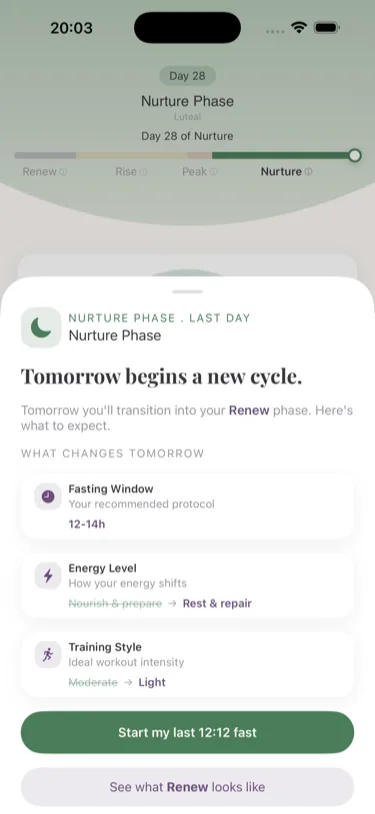
FastingBestie reads your cycle phase and adjusts your fasting window, meals, and training as your hormones shift, so you always know today’s plan without rebuilding it.