Foundations
Cycle-Synced Fasting: A Complete Guide
A phase-by-phase guide to intermittent fasting and your menstrual cycle. Learn when to extend your window, ease off, eat more, and rest more.
Educational content created by the FastingBestie team and maintained against the sources linked below. Research on cycle-synced fasting specifically is still emerging, so these guides combine direct evidence with broader fasting and menstrual-health literature. Read our editorial policy.
Cycle-synced fasting is the idea that your fasting practice should change across the month, because your body does. The book that put cycle-synced fasting on the map is Dr Mindy Pelz’s; our review of Fast Like a Girl covers what it gets right and where its specific claims outrun the evidence. It is the practical answer to how intermittent fasting and the menstrual cycle fit together: same tool, different settings depending on the week. This guide is the whole-cycle version of what that looks like, one phase at a time, with a practical playbook for each.
If you haven’t read our general guide to intermittent fasting for women yet, that’s a good first read. This guide goes deeper into the phase-by-phase specifics.
How intermittent fasting and your menstrual cycle interact
Intermittent fasting and your menstrual cycle interact through the same hormones that define each phase. Kept gentle, with moderate windows and enough food, fasting sits alongside a healthy cycle without much trouble. Pushed too hard, with long daily fasts and under-eating, it can disrupt the signals that regulate ovulation and lead to lighter, later, or missed periods. The practical answer is to change the fast across the month instead of holding one schedule, which is what the rest of this guide covers.
The short version
A menstrual cycle has four phases. Each one has a different hormone mix, a different energy level, and a different answer to “how should I fast today?”
| Phase | Days (typical) | What’s high | What to do |
|---|---|---|---|
| Menstrual | 1 to 5 | Neither estrogen nor progesterone | Rest. 12-hour overnight window. Eat iron and warmth. |
| Follicular | 6 to 13 | Estrogen rising | Push. 14 to 16 hour window. This is the easy week. |
| Ovulatory | 14 to 17 | Estrogen peak, testosterone bump | Flex. 13 to 14 hour window. Keep it social-friendly. |
| Luteal | 18 to 28 | Progesterone dominant | Ease off. 12 to 13 hour window. Carbs earlier, dinner earlier. |
Those day ranges assume a 28-day cycle. Your cycle may be shorter or longer. What matters is where you are in your own cycle, not the specific date.
If you would rather follow this as a fixed weekly rhythm, our guide to the best fasting schedule for women turns the same idea into a repeatable schedule.
Phase 1: Menstrual
Days 1 to 5, counted from the first day of your period.
Both estrogen and progesterone are at their lowest. You’re losing iron. Your metabolism is slightly elevated, which means you’re burning more than usual at rest. Your body is doing real physical work.
Fasting: 12 hours overnight is plenty. If you don’t feel like fasting at all, don’t. A one-week break does nothing to your metabolic progress.
Food: iron-rich (red meat, liver, lentils, leafy greens), warm, cooked. Pair iron with vitamin C. Don’t skip carbs. Soups and stews feel right this week for a reason.
Training: gentle. Walking, yoga, mobility, light strength. Hard sessions are fine if you want them, but nothing to prove.
Mindset: give yourself the week. Every competent cycle-synced protocol builds in rest, because it’s what the research points to. Covered in more detail in our fasting during your period guide.
Phase 2: Follicular
Days 6 to 13, roughly.
Estrogen starts climbing after your period ends and keeps rising until just before ovulation. With it, your mood lifts, your energy comes back, your insulin sensitivity improves, and your appetite dampens slightly. This is the phase that standard fasting advice was implicitly written for, because for these days, standard fasting advice actually works.
Fasting: 14 to 16 hours is comfortable for most women. Some women extend to 17 or 18 hours later in this phase with no ill effect. This is the phase to try a longer window if you want to.
Food: lighter, fresher, more variety. Your body handles carbs well this week. Good time for fermented foods (helps estrogen metabolism), leafy greens, and plenty of protein.
Training: push. Strength training, intensity work, new PRs. This is the phase your body is primed for hard work.
Mindset: take advantage of this week instead of coasting through it. If you have a hard project, a hard workout, a hard conversation, do it now.
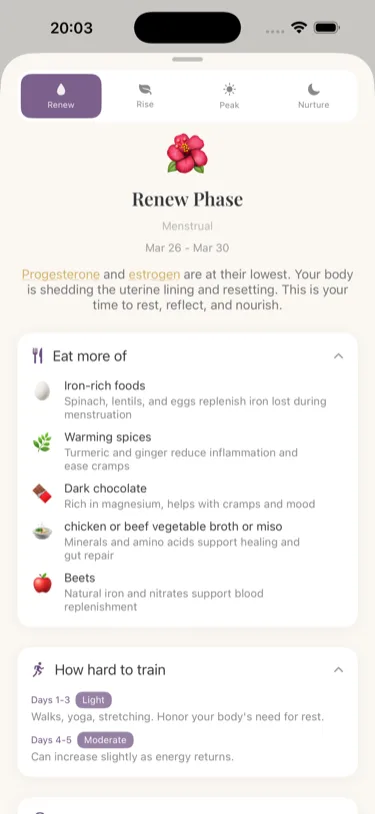
FastingBestie app
Fasting that adapts to your cycle
The app works out your cycle phase automatically and tells you what to eat, when to fast, and when to ease off, so your plan adjusts itself every week.

Phase 3: Ovulatory
Days 14 to 17, roughly.
Estrogen hits its peak and there’s a small bump of testosterone. You feel good. You feel social. You want to be out, not eating carefully in the kitchen at 11am.
Fasting: keep it flexible. 13 to 14 hours is fine. If you have a brunch planned or a dinner out, just do the fast on either side of it. This is not the week to win at fasting. Our guide to fasting during ovulation covers this peak-energy window in more detail.
Food: balanced, including some fat (your body uses it well during ovulation). Protein at every meal. Water intake matters more than usual. Ovulation bumps body temperature and you’ll need more fluid.
Training: still strong, but rotate toward conditioning over max-strength. Intervals, circuits, sports.
Mindset: do not let rigidity ruin a good week. The fasting practice that lasts is the one that coexists with your life.
Phase 4: Luteal
Days 18 through the end of your cycle. This is the phase that makes or breaks most women’s fasting practice.
Progesterone takes over. It’s a calming hormone at baseline, but it also lowers insulin sensitivity, raises body temperature, disrupts sleep, and increases appetite, especially for carbohydrates and fat. Your cortisol baseline creeps up. Late luteal (the week before your period) is where PMS lives.
If you try to run a 16:8 or longer here, four things usually happen: you get hungrier than usual, you sleep worse, your workouts tank, and by the time your period arrives you’re wrecked. That isn’t fasting failing. That’s fasting in the wrong gear.
Fasting: shorten to 12 or 13 hours. Eat dinner earlier (6 to 7pm works well) and breakfast at a normal time. Finishing eating earlier in the day is the single most useful adjustment in this phase. For the full playbook, see our guide to fasting during the luteal phase.
Food: more complex carbs (oats, rice, sweet potato), more magnesium (dark chocolate, nuts, seeds), steady protein. Limit refined sugar if you can; it’ll make the hormonal roller coaster worse. Don’t skip meals.
Training: drop intensity. Longer, steadier sessions work better than short and hard. Lots of women find their best cardiovascular base is built in the luteal phase, precisely because their bodies can’t sprint but can cruise for a long time.
Mindset: accept that this week is different. You’re not getting weaker. You’re not losing your gains. You’re respecting a hormonal context that won’t last forever, and you’ll come out the other side with a cycle that works.
Common patterns (and what they mean)
A few things show up when women first try cycle-synced fasting.
“Week 2 feels amazing and then week 4 is awful.” This is correct. Don’t interpret the contrast as failure. It’s the point. The whole protocol is built around respecting that contrast.
“I’m hungrier in my luteal phase even with a shorter window.” Expected. You’re burning more, your body wants more, and your progesterone is raising appetite. Eat more. Focus on protein and complex carbs. You’ll still lose weight if weight loss is your goal, because across the whole month the average will be consistent.
“My period moved / lightened / disappeared.” Pull back. Cycle changes are the most important signal your body can give you. Shorten your windows everywhere, eat more, and if it doesn’t return within 2 or 3 cycles, see a doctor. This is true whether you’re fasting or not. For the fuller picture on where fasting helps and where it does harm, see our guide on whether intermittent fasting is bad for you.
“I want to do this but my cycle is irregular.” You still can. Track by symptom instead of by date. When you feel the classic late-luteal signs (bloating, sleep changes, carb cravings, breast tenderness), that’s your signal to shift into luteal mode. When you feel the classic follicular rise (more energy, lighter mood, appetite dropping), shift into follicular mode. Your body is still cycling, even if the dates aren’t reliable.
How FastingBestie does this for you
The whole point of the FastingBestie app is that you don’t have to remember any of the above. The app reads your cycle automatically via Apple Health, or from a manual entry, works out which phase you’re in today, and adjusts your fasting window, food guidance, and workout intensity recommendations to match. When you move into a new phase, it tells you what’s changing and why.
The food side of each phase has its own playbook in our guide to cycle syncing your diet. See how the app works for the full feature walk-through, or explore the guides library for phase-specific deep dives.
If you remember one thing
Track your cycle. You cannot do cycle-synced fasting without knowing where you are in your cycle. Everything else (the specific windows, the food choices, the training intensity) flows from that single number: what day are you on today?
Track your cycle, match your fasting to it, and you’ll find that the version of intermittent fasting that finally works for you isn’t more aggressive than what you’ve tried before. It’s smarter about when.
Frequently asked
- What is cycle-synced fasting?
- Cycle-synced fasting is an approach where your fasting window, food choices, and exercise intensity change depending on where you are in your menstrual cycle. Instead of a fixed schedule like 16:8 every day, you lengthen your window when estrogen is rising and energy is high, and shorten or skip the fast when progesterone is dominant or you're menstruating.
- Do I need to track my cycle to fast this way?
- Yes, though it's lightweight. All you really need is your last period start date and an approximate cycle length. From that, everything else (what phase you're in today, what's coming next) can be worked out. The FastingBestie app does this automatically.
- What if my cycle is irregular?
- Cycle-synced fasting still works. It just takes a different framing. Instead of tracking by date, track by symptom: energy, mood, sleep quality, cravings. Your body still moves through hormonal patterns even when the timing isn't perfectly predictable. Irregular cycles are actually where a gentle, cycle-aware approach tends to help most.
- Can I fast this way with PCOS, perimenopause, or after menopause?
- Yes, and many women find it works better than standard protocols. For PCOS, the insulin-sensitivity support from gentle fasting in the right phases can be genuinely helpful. For perimenopause, cycle-aware fasting respects the chaotic hormone swings typical of that stage. Post-menopause, the cycle is gone but the same principles of moderation and food-quality-over-fasting-window still apply.
- How is this different from just doing 16:8?
- A fixed 16:8 schedule ignores what your body is doing hormonally. On a good day in your follicular phase, 16:8 is easy. In your luteal phase, it's working against cortisol, insulin, and progesterone all at once. Cycle-synced fasting uses the same tool (time-restricted eating) applied with timing that matches your biology.
- How does intermittent fasting affect your menstrual cycle?
- Done gently, intermittent fasting and your menstrual cycle can coexist without trouble. Pushed too hard, especially long daily fasts combined with under-eating, fasting can disrupt the hormonal signals that regulate ovulation and lead to lighter, later, or missed periods. The fix is to keep windows moderate, eat enough, and ease off during your period and the late luteal week.
References and further reading
- The Menstrual Cycle: Menstruation, Ovulation, and How Pregnancy Occurs (ACOG)
- Menstruation and Menstrual Problems (NICHD)
- Intermittent Fasting in Female Reproduction: A Double-Edged Sword (Yang et al., Nutrition Reviews)
- Effects of Intermittent Fasting on Health, Aging, and Disease (de Cabo & Mattson, NEJM review)
- Exercise performance at different phases of the menstrual cycle: measurements, differences, and mechanisms (Wen et al., Frontiers in Endocrinology review)
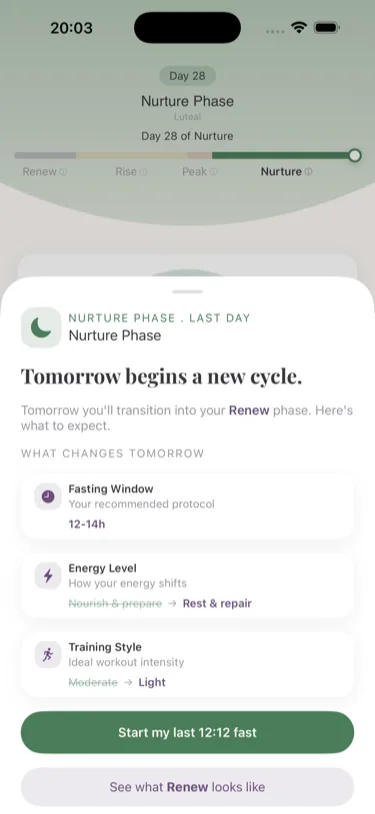
FastingBestie app
Skip the guesswork
FastingBestie reads your cycle phase and adjusts your fasting window, meals, and training as your hormones shift, so you always know today’s plan without rebuilding it.
FastingBestie provides evidence-informed guidance, not a substitute for professional medical advice. If you're pregnant, breastfeeding, have a history of disordered eating, or are managing a medical condition, talk to your doctor before starting or changing a fasting routine.