Menstrual phase
Fasting During Your Period: What to Do (and What to Skip)
Should you fast on your period? The short answer: not the way you would the rest of the month. Here's what's actually going on and how to adjust.
Educational content created by the FastingBestie team and maintained against the sources linked below. Research on cycle-synced fasting specifically is still emerging, so these guides combine direct evidence with broader fasting and menstrual-health literature. Read our editorial policy.
If you’ve been fasting consistently and then hit day one of your period and felt terrible, you’re not imagining it. The answer isn’t to push through. The answer is to understand what’s changing and adjust your approach for the week.
What’s actually happening during your period
During menstruation, estrogen and progesterone are both at their monthly low. Those hormones do a lot of jobs. Two relevant ones: estrogen dampens appetite and stabilises mood; progesterone helps with sleep. Take them both away at once and you get the classic period-week combination of hungry, tired, and emotionally raw.
On top of the hormonal drop, your body is doing physical work. You’re shedding the uterine lining, losing iron in the process, and mildly inflamed. Your resting metabolic rate actually ticks up a little during menstruation. Your body is burning more calories than usual, not fewer.
Stack all of that against a 16-hour fast, and it’s no surprise it feels harder than usual.
What to do instead
The goal during your period is to support your body through the physiological work it’s already doing. That usually looks like:
- A gentle overnight window: 12 hours, roughly 8pm to 8am, works well for most women. This is still a fast. You still get autophagy, you still get stable blood sugar overnight, you still get the digestive break. You just stop pushing.
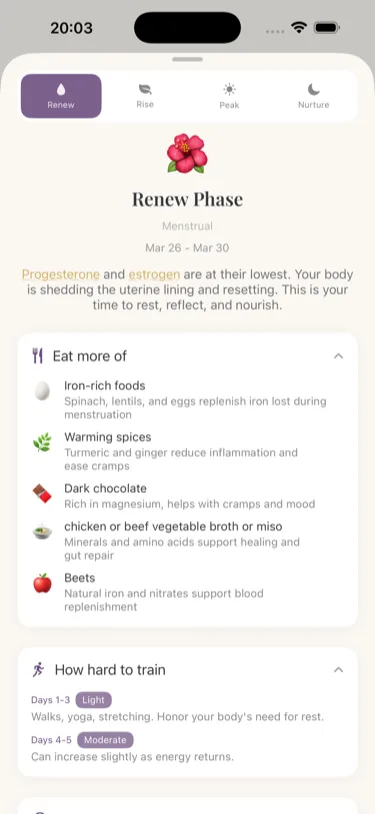
- Eat iron-rich food at your first meal: eggs with spinach, steak with leafy greens, lentils with tomato, or organ meat if you’re brave. Iron absorption is better when paired with vitamin C (peppers, citrus, tomatoes).
- Keep it warm and cooked: soups, stews, roasted vegetables, porridge. Cold salads and smoothies are harder to digest and don’t feel good when cramping.
- Don’t skip carbs: this is not the week to test keto or ultra-low-carb. Complex carbs like oats, rice, sweet potato, and beans support serotonin, help sleep, and settle cravings.
- Cut caffeine earlier in the day: caffeine makes cramps and sleep worse. Stop around lunchtime.
What to skip
- Extended fasts (18+ hours). Save these for the second week of your cycle, when estrogen is rising and they genuinely feel easy.
- Hard fasted workouts. Move your body, but keep it gentle: walking, yoga, light strength work. If you want to train hard, eat first.
- Aggressive low-carb. Your brain is running slightly lower on serotonin this week. Pulling carbs out will make that worse.
- New experiments. This isn’t the week to test a new fasting protocol, a new diet, or a 24-hour fast. Your body is telling you what it needs. Listen.
FastingBestie app
Fasting that adapts to your cycle
The app works out your cycle phase automatically and tells you what to eat, when to fast, and when to ease off, so your plan adjusts itself every week.

How long does this “light” week last?
Typically 3 to 5 days. Once your bleeding tapers off and you’re into the back half of the follicular phase, energy climbs quickly. Most women feel visibly different by day four or five, and by the end of week one they’re back to a longer fasting window feeling effortless.
That’s the part of the cycle fasting was written for. Week one is the part it wasn’t. Most fasting books skip this week altogether, which is why our roundup of the best intermittent fasting books for women ranks the ones that account for your period highest.
How the app handles this for you
The FastingBestie app recognises when you’re in your menstrual phase and adjusts its recommendations automatically: shorter windows, food guidance focused on iron and warmth, workout intensity dialled back. You don’t have to remember to switch modes. See how the app works if you want the full picture, or read our complete guide to cycle-synced fasting for the whole-cycle view.
The rule of thumb
If fasting during your period is making the rest of the week worse (worse sleep, worse mood, worse energy), you’re fasting too aggressively. Shorten the window, eat more, and come back to longer fasts next week. You’ll lose nothing. You’ll probably gain a more sustainable fasting practice as a result.
Frequently asked
- Can you fast during your period?
- Yes, but lightly. A 12-hour overnight fast, for example finishing dinner at 8pm and eating breakfast at 8am, is comfortable for most women and gives the same metabolic benefit you'd get any other week. Extended fasts and aggressive windows are not a good fit during menstruation.
- Is it bad to fast on the first day of your period?
- It isn't dangerous, but it's rarely useful. Day one is often the lowest-energy day of the cycle. You're losing iron, your uterus is working hard, and your body is under real physiological load. Adding a 16 or 18 hour fast on top tends to make everything feel worse without any matching benefit.
- Why am I so hungry during my period when I usually fast easily?
- A few reasons: your metabolism actually runs slightly higher during menstruation, estrogen and progesterone are both low (removing their appetite-dampening effect), and your body is working to replace lost iron and rebuild tissue. That hunger is physiological, not a failure of willpower.
- Will breaking my fast during my period mess up my weight loss?
- No. One week of a shorter fasting window, or no fasting at all, will not undo your progress. The research on fasting for women is increasingly clear that cycling your approach, rest weeks included, often works better than doing the same thing every day.
- What should I eat during my period if I've been fasting the rest of the month?
- Focus on iron (red meat, liver, lentils, leafy greens), protein at every meal, warm cooked food over cold raw food, magnesium (dark chocolate, pumpkin seeds, nuts), and enough carbs to feel normal. This isn't the week for a low-carb experiment.
References and further reading
- The Menstrual Cycle: Menstruation, Ovulation, and How Pregnancy Occurs (ACOG)
- Menstruation and Menstrual Problems (NICHD)
- Intermittent Fasting in Female Reproduction: A Double-Edged Sword (Yang et al., Nutrition Reviews)
- Endocrine and chronobiological effects of fasting in women (Berga et al., Fertility and Sterility)
FastingBestie app
Skip the guesswork
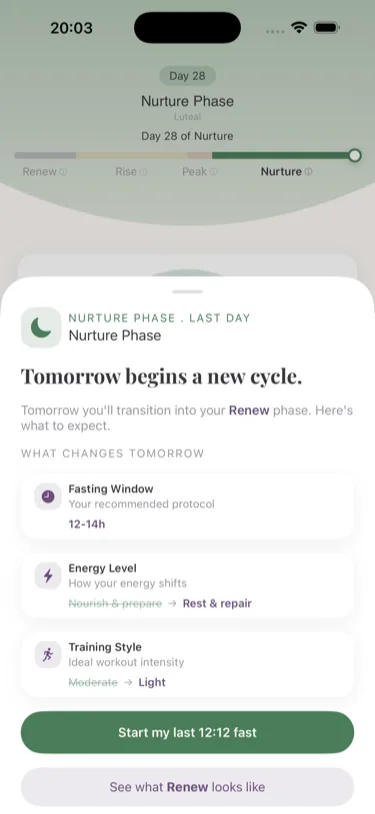
FastingBestie reads your cycle phase and adjusts your fasting window, meals, and training as your hormones shift, so you always know today’s plan without rebuilding it.
FastingBestie provides evidence-informed guidance, not a substitute for professional medical advice. If you're pregnant, breastfeeding, have a history of disordered eating, or are managing a medical condition, talk to your doctor before starting or changing a fasting routine.