Foundations
Intermittent Fasting for Women: A Practical, Cycle-Aware Guide
Most fasting advice was written for men. Here's what works for women, how your cycle changes the rules, and how to start safely.
Educational content created by the FastingBestie team and maintained against the sources linked below. Research on cycle-synced fasting specifically is still emerging, so these guides combine direct evidence with broader fasting and menstrual-health literature. Read our editorial policy.
Most of what’s written about intermittent fasting was written for men, or written as if the female body was just a smaller version of a male one. It isn’t. A woman’s body runs on a roughly 28-day cycle, and that cycle changes almost everything that matters for fasting: your energy, your insulin sensitivity, your cortisol, your sleep, and how much willpower you have on any given day.
This guide walks through what actually works for women, why the usual “just do 16:8” advice misses the point, and how to start in a way that doesn’t wreck your hormones or your week. If you want to see how the popular books handle (and mostly miss) that, we reviewed and ranked the best intermittent fasting books, with the women-first titles at the top.
Why fasting works differently for women
Female physiology is more sensitive to calorie restriction than male physiology. From an evolutionary angle, that makes sense: the body that can get pregnant needs to be cautious about signalling “food is scarce.” When fasting is too aggressive or too constant, the female body reads that signal and responds by ramping down reproductive function. That shows up as later ovulation, lighter or missed periods, lower libido, disrupted sleep, and a stress response that makes weight loss harder rather than easier.
That doesn’t mean women shouldn’t fast. It means the dose matters. A thirteen-hour overnight fast four days a week is very different from 18:6 every day. The first is a gentle metabolic nudge. The second is a loud signal that resources are scarce.
The other factor is the cycle itself. Across 28 days, estrogen, progesterone, and insulin sensitivity all move. What feels easy in week one feels awful in week four, and that isn’t a willpower problem. It’s a hormone problem.
What changes across your cycle
Here’s the simple version of what’s happening and what it means for fasting.
Menstrual phase (days 1 to 5)
Estrogen and progesterone are at their lowest. You may have cramps, fatigue, or low iron. Your body is working hard already. This is the week to drop any ambitious fasting plan and focus on eating well, staying warm, and sleeping. A light 12-hour overnight window is plenty.
Follicular phase (days 6 to 13)
Estrogen starts rising, and with it your energy, mood, and insulin sensitivity. This is the phase fasting advice was implicitly written for. You can sit comfortably at a 14 to 16 hour window, some women can go longer, and you’ll barely notice it.
Ovulatory phase (days 14 to 17)
Estrogen peaks and testosterone has a small bump. You feel good, you want to be social, you probably have meals out. Keep fasting flexible. A 14-hour window is fine. Forcing 18:6 because the calendar says so is not.
Luteal phase (days 18 to 28)
Progesterone takes over. Insulin sensitivity drops, cortisol rises, sleep gets lighter, and your body wants more food, especially carbs. Long fasts in this phase are the single biggest reason women try intermittent fasting and quit, convinced it doesn’t work for them. It does work, just not on the same schedule as the rest of the month. Shorten your window to 12 or 13 hours, eat earlier in the day, and include complex carbs with dinner.
A starter schedule that actually works
If you’re new, don’t start with 16:8 every day. Start here:
| Week of cycle | Fasting window | Notes |
|---|---|---|
| Week 1 (menstrual) | 12 hours or none | Rest and recover. Focus on iron, protein, and sleep. |
| Week 2 (follicular) | 13 to 14 hours | This is the easy week. Eat breakfast a bit later. |
| Week 3 (ovulatory) | 13 to 14 hours | Keep it flexible; don’t skip social meals. |
| Week 4 (luteal) | 12 to 13 hours | Dinner earlier, carbs a little higher, stop pushing. |
After one full cycle, you’ll know which phases you can extend a little. Follicular week is often where women find they can comfortably move to a 15 or 16 hour window. The luteal week almost never is. For a repeatable weekly version of this, see our guide to the best fasting schedule for women.
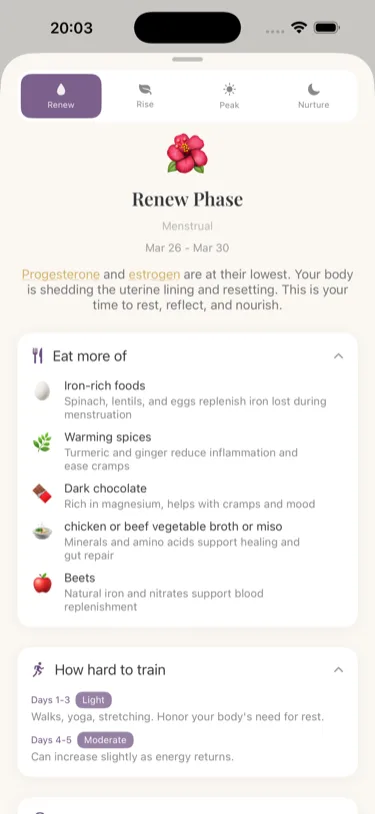
FastingBestie app
Fasting that adapts to your cycle
The app works out your cycle phase automatically and tells you what to eat, when to fast, and when to ease off, so your plan adjusts itself every week.

Common mistakes to avoid
- Starting with OMAD or 20-hour fasts. These work for some people some of the time, but they’re an aggressive starting point for anyone and a particularly bad one for women who haven’t built up to them across a cycle.
- Fasting through your period. If you’re bleeding, eat. There’s no metabolic upside to fasting during menstruation that outweighs feeling awful for five days.
- Ignoring your cycle because it’s “irregular.” If you have PCOS, perimenopausal symptoms, or a cycle that swings, you can still fast. A structured approach helps even more in that case. Track symptoms instead of dates, and err toward gentler windows.
- Under-eating protein. Women chronically under-eat protein. Pair shorter fasts with a genuine 25 to 35g protein hit at every meal and you’ll see more change than adding another fasted hour.
- Training hard fasted in the luteal phase. This is the combination most likely to blow up sleep and appetite. Either eat first, or move the hard session earlier in your cycle.
How the FastingBestie app fits in
The app does all of this work for you. It reads your cycle phase automatically via Apple Health or from a manual entry, chooses a fasting window appropriate to where you are, and adjusts your recommendations when you enter a new phase. You don’t have to remember any of the week-by-week detail above. The app does it. See how the app works for more.
If you’d rather understand the science first, start with our guide to cycle-synced fasting or read what the research says about fasting during your period.
When to stop
Fasting is a tool. Like any tool, it has failure modes. Stop or pull back if you notice:
- Your period gets lighter, later, or stops.
- You’re sleeping worse than you were before you started.
- You’re thinking about food constantly or having binge cravings.
- Your mood is consistently flatter, more anxious, or more irritable.
- Your workouts are getting noticeably weaker.
None of these mean fasting doesn’t work for women. They mean the dose is wrong for you right now. Shorten the window, add a meal, and pay attention. If you are still weighing it up, our guide on whether intermittent fasting is bad for you covers the risks and the limits in full.
Frequently asked
- Is intermittent fasting safe for women?
- For most healthy women, yes, provided you keep the fasting window modest and adjust it across your cycle. The risks rise when women copy aggressive male-style protocols (long fasts, very low calories, fasting every day regardless of cycle phase). If you have a history of disordered eating, are pregnant or breastfeeding, or are managing a medical condition, speak to your doctor first.
- What's the best fasting window for women?
- There isn't one fixed window. In the follicular phase (roughly days 6 to 13) most women can sit comfortably at a 14 to 16 hour fast. In the luteal phase (roughly days 18 to 28) a 12 to 13 hour window usually feels better. During your period, many women do best without any fast at all for a few days.
- Does intermittent fasting affect your period?
- It can. Fasting too aggressively, especially during the luteal phase, has been linked to cycle irregularity, later ovulation, and in some women a missed period. If your cycle changes after you start fasting, shorten your window or stop. Your cycle is a vital sign, not a side effect.
- Can I lose weight with intermittent fasting as a woman?
- Yes, but sustainable weight loss comes from the total picture: energy balance, protein intake, strength training, and sleep. Fasting is a tool that makes eating within a reasonable amount easier for many people. It isn't a magic trigger.
- How long before I see results?
- Most women notice better energy and less bloating within two weeks. Weight changes usually appear between weeks two and four. The biggest difference tends to show up after one full cycle of cycle-aligned fasting, when your body has adapted across every phase.
References and further reading
- Effects of Intermittent Fasting on Health, Aging, and Disease (de Cabo & Mattson, NEJM review)
- Intermittent and periodic fasting, longevity and disease (Longo et al., Nature Aging review)
- Intermittent Fasting in Female Reproduction: A Double-Edged Sword (Yang et al., Nutrition Reviews)
- Endocrine and chronobiological effects of fasting in women (Berga et al., Fertility and Sterility)
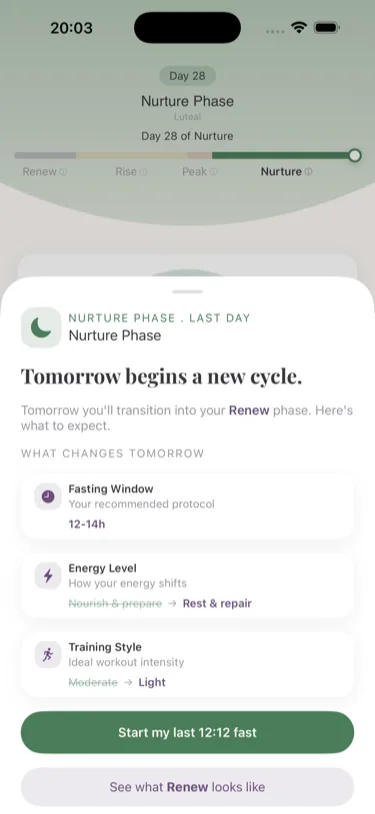
FastingBestie app
Skip the guesswork
FastingBestie reads your cycle phase and adjusts your fasting window, meals, and training as your hormones shift, so you always know today’s plan without rebuilding it.
FastingBestie provides evidence-informed guidance, not a substitute for professional medical advice. If you're pregnant, breastfeeding, have a history of disordered eating, or are managing a medical condition, talk to your doctor before starting or changing a fasting routine.