Building the guard rails
When we tell people we are building a fasting app for women, a fair number of them flinch. Their worry is some version of the same thing: that fasting can push people to eat too little, or to turn food into a set of rules they feel they have to obey. It is a fair concern, and it deserves a better answer than a line in the terms of service.
So before we built the parts of the app that make fasting feel rewarding, we built the parts that hold it back. We call them the guard rails.
What a guard rail looks like for us
A guard rail is a limit the app enforces by default, at the point where the decision happens. It sits inside the recommendation itself rather than in a paragraph you scroll past during onboarding, so the easy path and the safe path are the same path.
The clearest example is the fasting window. Our engine never recommends a window shorter than 12 hours or longer than 20. There is no setting to push the daily recommendation past that. The ceiling is built into the math, so it holds even in a burst of motivation.
The cycle does the heavy lifting
The most important guard rail is that the recommendation changes with your cycle, and it eases off in the phases where many women find a hard fast hardest to sustain. The reasoning behind that, and the research it draws on, sits in our guide on whether fasting is bad for you and on the science page.
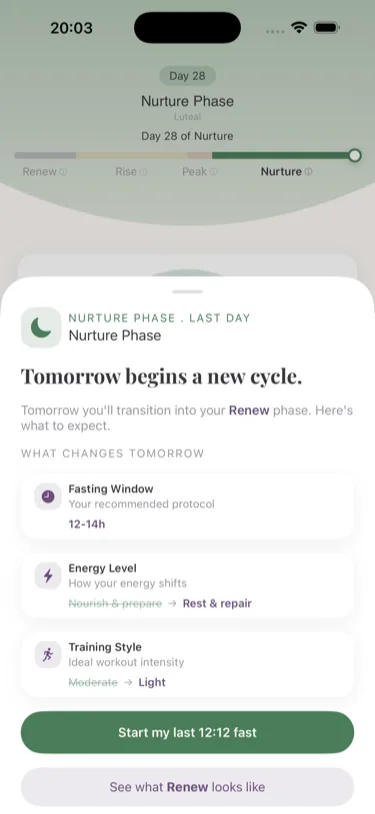
In the luteal phase, the week or two before your period, the app recommends a shorter, gentler window and stops offering the most aggressive protocols. In the ovulatory phase it does the same. During your period, the window is tempered, and the app offers a self-care note: if you have heavy bleeding, fatigue, or cramping, you can shorten or skip the fast and pick it up again when your energy returns.
That last one matters more than it looks. A lot of fasting culture treats a skipped fast as a broken streak, a small failure to feel bad about. We treat it as a normal, healthy choice your body is allowed to make.
When someone wants to go further
Here is the harder design problem. Some people will want to do longer fasts than we recommend, and telling them no does not make them stop. It just means they go and do it somewhere with no guidance at all, off a screenshot from a forum.
We do not recommend long fasts, and our daily guidance stays inside that 12 to 20 hour range. The app does let you start a longer fast by hand, and before the longest ones it shows a safety acknowledgement you have to accept first. That screen is blunt on purpose: fasts this long can affect blood sugar, blood pressure, electrolytes, and medication, they are not right for everyone, and you should talk to a doctor first if you take medication, manage a condition, are pregnant or nursing, or have a history of disordered eating. For the people a long fast suits, the point is to go in understanding what it does to the body rather than doing it blind. This is warning-gated information, not a recommendation, and it is the safer position we landed on.
This is the philosophy across the whole product. Whatever someone decides to do, our job is to give them the information that keeps them safe.
The promise underneath
A while ago we wrote about building with promises, the short commitments we write down before we build the features that have to keep them. One of them was this:
We’ll treat you with respect and support.
The guard rails are how that promise becomes code. Respect means we do not exploit the part of a person that wants to push harder and eat less. Support means that when your body asks for a break, the app hands it to you instead of trying to guilt you past it.
We would rather lose the user who wants an app that pushes them to extremes than keep them and watch it hurt. If you ever feel the product nudging you the wrong way, tell us. That is the kind of bug we most want to hear about.
FastingBestie app
Skip the guesswork
FastingBestie reads your cycle phase and adjusts your fasting window, meals, and training as your hormones shift, so you always know today’s plan without rebuilding it.