Foundations
Is Intermittent Fasting Bad for You?
For most healthy women, intermittent fasting is not harmful when it follows your cycle and leaves room for enough food. When it helps and when it hurts.
Educational content created by the FastingBestie team and maintained against the sources linked below. Research on cycle-synced fasting specifically is still emerging, so these guides combine direct evidence with broader fasting and menstrual-health literature. Read our editorial policy.
For most healthy women, intermittent fasting is not inherently bad. The honest answer is that it depends on how you do it. A 13-hour overnight window with regular, protein-rich meals is a very different thing from an 18-hour fast every day on top of hard training and not enough food. Same word, opposite effect on your body.
So the question worth asking is not whether fasting is good or bad in the abstract. It is whether a particular way of fasting is right for you, right now, in this phase of your cycle. Our guide to intermittent fasting for women covers how to do it well, and this one focuses on the risks and the limits. If you want that risk-aware view from a physician-scientist, our review of The Fasting Fix covers the most evidence-cautious book on fasting we have read.
Where the worry comes from
Some of the people who push back on fasting are not being difficult. They are pointing at something real. Skipping meals, following strict rules about when you are allowed to eat, and feeling in control of your food intake are patterns that also show up in disordered eating. The National Institute of Mental Health describes eating disorders as serious illnesses, and lists fixation on weight, body shape, and controlling food among the warning signs.
We take that overlap seriously rather than waving it away. Any framework that puts rules around food can be bent toward restriction by someone who is vulnerable to it. Fasting is no exception. Pretending otherwise would be dishonest, and it would make the app less safe.
What the research does not show is that intermittent fasting, on its own, causes eating disorders in otherwise healthy people. Eating disorders are complex, with genetic, psychological, and social roots, and fasting is one factor among many rather than a single cause. The risk worth taking seriously is narrower and more practical: someone who is already prone to restriction can use a fasting schedule as cover for eating too little.
If that sounds like you, if food already comes with anxiety, rigid rules, or a history of an eating disorder, fasting is not a safe way to manage it, and this is one of the cases where the right move is to skip fasting and speak to a professional. We design the app to lower the risk for the people it suits, but it cannot see what only you and a clinician can.
Structured eating windows and disordered eating are not the same thing
The difference is in the intent and the effect, not just the clock.
Cycle-aware fasting is built to make sure you eat enough good food inside a sensible window, then close the kitchen overnight so your body gets a real break. It responds to how you feel. When energy drops or your period arrives, the right move is to eat more and fast less.
Disordered eating runs the other way. It is driven by fear, punishment, and a sense that more restriction is always better. Hunger becomes something to win against. Eating becomes something to feel guilty about. The rules get tighter over time instead of looser when the body asks for more.
A useful test: if your fasting routine only ever gets stricter, never lets up around your period, and leaves you anxious about eating, it has stopped being a wellness habit. That is a signal to pull back, and our guide on when to stop fasting walks through the warning signs in detail.
How fasting goes wrong for women
When fasting harms women, it is usually because the protocol was written for a male body and applied without adjustment. The common mistakes look like this:
- Fasting too long, every day. A 16 or 18 hour window seven days a week, regardless of cycle phase, is more than many women feel good on. For some it shows up as worse sleep, low energy, or changes to the cycle.
- Eating too little inside the window. A short eating window plus low protein and low total calories is under-eating with extra steps.
- Ignoring the luteal phase. The week or two before your period is when many women find fasting hardest. Pushing a long fast here can make sleep, mood, and appetite worse rather than better.
The cost shows up in your cycle first. Research on fasting and female reproduction describes it as a double-edged sword: helpful within limits, disruptive past them. Aggressive fasting has been linked to later ovulation and changes to the menstrual cycle, and a missing period (amenorrhea) is a recognised sign that the body is under too much energy stress. Your cycle is a vital sign, and a lighter, later, or absent period is the clearest warning that the dose is wrong.
Why we recommend by cycle, not by willpower
Most fasting advice rewards grinding harder. Longer windows, more discipline, more streaks. For women, that is the part that does the damage.
Our approach moves the other way. The recommendation gets gentler exactly when your body needs it to:
- In the follicular phase, after your period, energy is rising and longer windows feel easiest. This is the phase to test a slightly longer fast if you want to.
- In the ovulatory and luteal phases, the recommendation softens to shorter, gentler windows. The most aggressive protocols are not offered here at all.
- During your period, the window is tempered, and you can shorten or skip the fast entirely on the days you have heavy bleeding, fatigue, or cramps.
You do not have to remember any of this. The app reads your phase and adjusts for you, so the easy path and the safe path are the same path. If you want the full model, the complete cycle-synced fasting guide lays it out phase by phase.
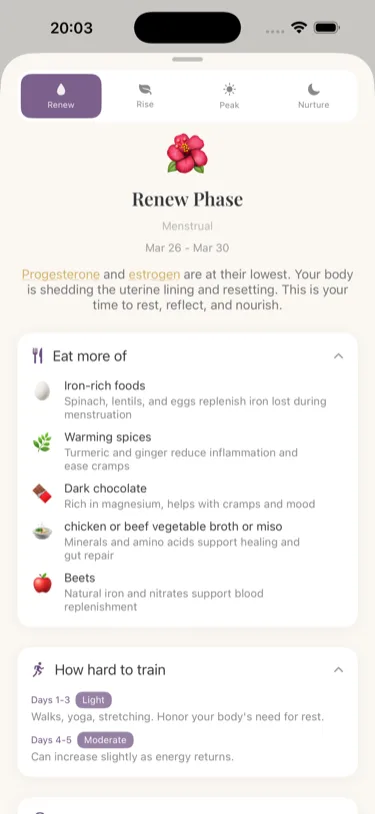
FastingBestie app
Fasting that adapts to your cycle
The app works out your cycle phase automatically and tells you what to eat, when to fast, and when to ease off, so your plan adjusts itself every week.

The guard rails, briefly
Safety in the app is built into the defaults rather than buried in a disclaimer. A few of the limits:
- Daily recommendations stay inside a sensible range and never push you toward extreme windows.
- The gentler phases cap the fast lower, and the hardest protocols are withheld when your body is least suited to them.
- During your period, skipping the fast is offered as a normal option, not a failure.
We wrote about how and why we built these limits in a separate Journal post, building the guard rails. The short version: we would rather hold you back than let the product talk you into something that hurts.
Long fasts: we do not recommend them, and we will not pretend you won’t try
Our daily guidance stays within a 12 to 20 hour range, and we think that is where cycle-aware fasting belongs. Longer fasts of 24 hours or more carry more risk to your energy, sleep, and cycle, and the benefits for women are far less settled than the marketing suggests.
We also know that some people will do them regardless of advice. So the app does not lock the door and look away. Its daily recommendation stays in that 12 to 20 hour range and never pushes you past it, and it does let you start a longer fast by hand. Before the longest ones it shows a safety acknowledgement you have to accept first, covering the effects on blood sugar, blood pressure, electrolytes, and medication, and when to talk to a doctor. Someone who understands what a long fast does to their body is safer than someone doing it blind off a screenshot from the internet. Informed choice is the safer harm-reduction position, and it is the one we take.
If you are doing longer fasts often, or reaching for them to make up for eating too much or too little, that is worth examining honestly. The pattern matters more than any single day.
Who should not fast
Intermittent fasting is educational lifestyle guidance, not medical advice, and it is not for everyone. Do not start, and speak to a healthcare professional first, if you:
- are pregnant or breastfeeding
- have a history of an eating disorder or disordered eating
- are underweight
- take glucose-lowering medication such as insulin
- have a medical condition that fasting could affect
This is not fine print. If you are in one of these groups, the right answer may be that fasting is not for you, and that is a perfectly good answer.
So, is it bad for you?
Done in a way that fights your body, fasting can be. Long daily windows, too little food, and no break around your period add stress instead of removing it.
Done in a way that follows your physiology, with enough food and a window that eases off when your hormones do, it is a reasonable tool for many healthy women. The difference is the method, the food, and the willingness to stop when your body says to.
If you want that adjustment handled for you instead of carried in your head, the FastingBestie app reads your cycle and sets the window for you. If you would rather read first, the full guide library is the place to start.
Frequently asked
- Is intermittent fasting bad for you?
- For most healthy women, no, provided the fasting window is modest and adjusted across the cycle. It can become harmful when women copy aggressive protocols built for men: long daily fasts, very low calories, and no break around the period. If you are pregnant or breastfeeding, have a history of an eating disorder, or are managing a medical condition, speak to your doctor before fasting.
- Does intermittent fasting cause eating disorders?
- Fasting does not cause an eating disorder on its own. Eating disorders are serious medical illnesses with many contributing factors. That said, any eating framework with rules around food can be bent toward restriction by someone who is vulnerable, which is why we build in limits, recommend enough food, and tell you clearly when to stop.
- Can intermittent fasting affect your period?
- Yes. Fasting too aggressively, especially in the luteal phase, has been linked to later ovulation, lighter or missed periods, and cycle irregularity. Your cycle is a vital sign. If it changes after you start fasting, shorten your window or stop.
- Who should not do intermittent fasting?
- Anyone who is pregnant or breastfeeding, has a history of disordered eating, is underweight, takes glucose-lowering medication, or has a medical condition that fasting could affect should get individual medical advice first. The app is educational lifestyle guidance, not medical advice.
- Is it bad to do long fasts of 24 hours or more?
- We do not recommend long fasts for cycle-aware fasting, and our daily recommendations stay within a 12 to 20 hour range. Longer fasts carry more risk to energy, sleep, and cycle health. If you decide to do one anyway, do it with eyes open: know the warning signs and stop if you hit them.
References and further reading
- Eating Disorders (National Institute of Mental Health)
- Intermittent Fasting in Female Reproduction: A Double-Edged Sword (Yang et al., Nutrition Reviews)
- Effects of Intermittent Fasting on Health, Aging, and Disease (de Cabo & Mattson, NEJM review)
- Endocrine and chronobiological effects of fasting in women (Berga et al., Fertility and Sterility)
- Amenorrhea: Absence of Periods (ACOG)
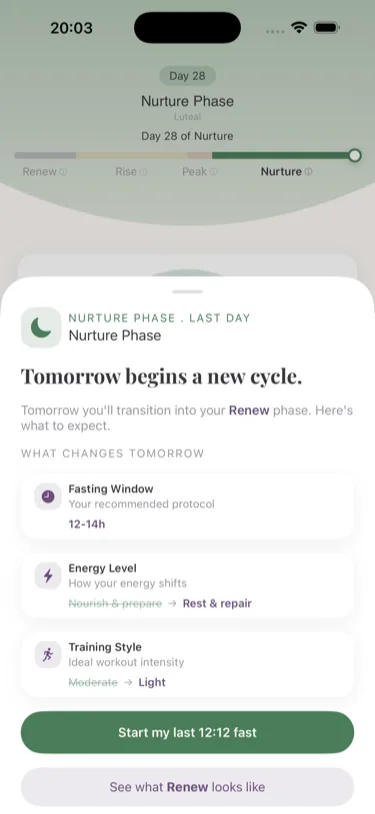
FastingBestie app
Skip the guesswork
FastingBestie reads your cycle phase and adjusts your fasting window, meals, and training as your hormones shift, so you always know today’s plan without rebuilding it.
FastingBestie provides evidence-informed guidance, not a substitute for professional medical advice. If you're pregnant, breastfeeding, have a history of disordered eating, or are managing a medical condition, talk to your doctor before starting or changing a fasting routine.