Foundations
When to Stop Fasting
Stop fasting when it starts costing you sleep, cycle health, mood, or recovery. These are the signs your routine is too aggressive.
Educational content created by the FastingBestie team and maintained against the sources linked below. Research on cycle-synced fasting specifically is still emerging, so these guides combine direct evidence with broader fasting and menstrual-health literature. Read our editorial policy.
You should stop fasting when it starts hurting more than it is helping. For women, the clearest signs are changes in your cycle, worse sleep, persistent fatigue, food obsession, dizziness, or a routine that keeps ending in rebound eating.
Stopping is not failure. It is feedback.
The main signs your fasting routine is too aggressive
These are the big ones:
- your period gets lighter, later, or disappears
- you feel wired at night but exhausted in the day
- you are hungry all the time
- you think about food constantly
- workouts are getting weaker
- your mood is flatter, snappier, or more anxious
- you break the fast at night and feel out of control
One bad day does not mean you need to quit. A pattern does.
Cycle changes are not a side note
For women, the menstrual cycle is a vital sign. If your cycle changes substantially after you start fasting, that is one of the strongest reasons to pause and reassess.
The common mistake is to write that off as “my body adjusting.” Sometimes it is. Sometimes it is your body saying the current setup is too much.
Sleep is another major red flag
A lot of women can white-knuckle hunger for a while. What usually gives the game away is sleep.
If you are waking up at 3am, feeling more anxious, or dragging through the second half of the day, your routine may be adding stress instead of reducing it.
That matters because bad sleep makes hunger, cravings, and insulin regulation worse. A fasting routine that breaks sleep often defeats its own purpose.
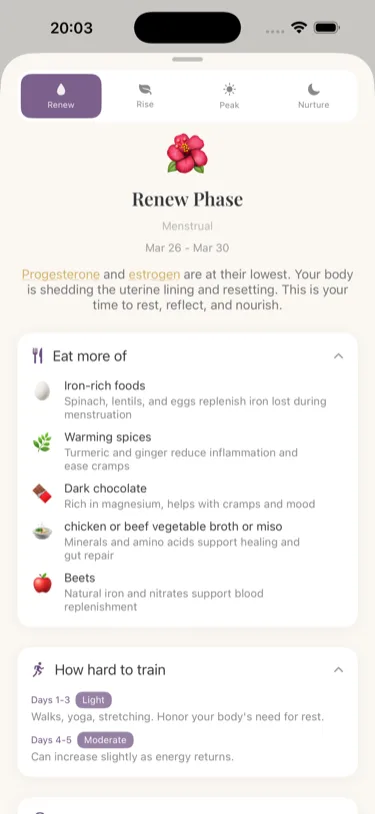
FastingBestie app
Fasting that adapts to your cycle
The app works out your cycle phase automatically and tells you what to eat, when to fast, and when to ease off, so your plan adjusts itself every week.

When to stop immediately
Stop immediately and get appropriate help if you are:
- pregnant or think you might be
- breastfeeding and struggling with energy or supply
- fainting, nearly fainting, or repeatedly dizzy
- caught in a binge-restrict cycle
- seeing major cycle changes
- fasting on top of a history of disordered eating
There is a difference between a wellness habit and a stressor that is no longer serving you.
What to do instead of “pushing through”
Usually the smartest next move is one of these:
- go back to a 12-hour overnight fast
- eat breakfast again for a while
- stop combining fasting with hard fasted training
- raise protein and total food intake
- shorten the fasting window in the luteal phase or during your period
If you want the gentler framework, go back to our guide to intermittent fasting for women or the phase-based version in the main cycle guide.
How to restart after stopping
Restart small.
That means:
- wait until sleep, mood, hunger, and cycle signals settle
- restart with 12 to 13 hours, not 16
- keep meals regular and protein-rich
- stop at the first sign you are repeating the old pattern
You can also let the FastingBestie app do the phase changes for you instead of trying to remember them under stress. If you want the rest of the library in one place, all guides is the easiest starting point.
The point of fasting is to make life simpler and metabolic health steadier. The moment it starts doing the opposite, it is time to stop.
Frequently asked
- When should a woman stop intermittent fasting?
- She should stop or pull back when the routine starts changing her cycle, worsening sleep, flattening workouts, increasing anxiety around food, or leaving her chronically drained.
- Should I stop fasting if my period changes?
- Yes, at least temporarily. A major cycle change is one of the clearest signals that the routine may be too aggressive for your current body, stress load, or food intake.
- Do I have to stop forever?
- Not usually. Many women do well after a reset, with shorter windows and better fueling. The problem is often the dose, not the concept of fasting itself.
- Who should be extra cautious before fasting?
- Women who are pregnant, breastfeeding, underweight, have a history of disordered eating, are taking glucose-lowering medication, or have a medical condition should get individualized advice before using fasting.
References and further reading
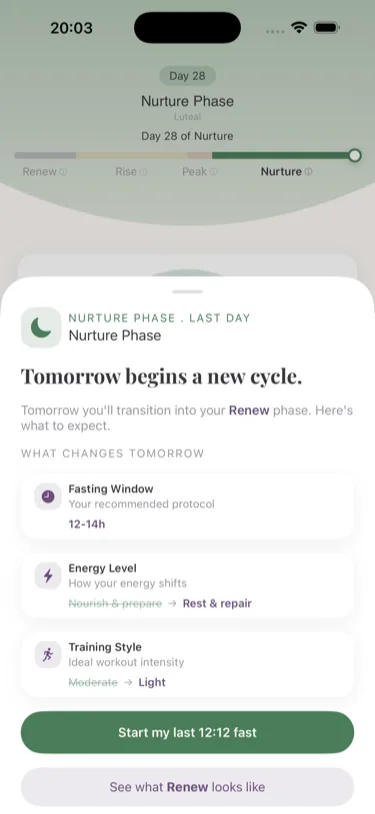
FastingBestie app
Skip the guesswork
FastingBestie reads your cycle phase and adjusts your fasting window, meals, and training as your hormones shift, so you always know today’s plan without rebuilding it.
FastingBestie provides evidence-informed guidance, not a substitute for professional medical advice. If you're pregnant, breastfeeding, have a history of disordered eating, or are managing a medical condition, talk to your doctor before starting or changing a fasting routine.