Luteal phase
Why Fasting Feels Harder Before Your Period
Fasting often feels harder before your period because the late luteal phase changes appetite, sleep, and stress tolerance. Here's what to do about it.
Educational content created by the FastingBestie team and maintained against the sources linked below. Research on cycle-synced fasting specifically is still emerging, so these guides combine direct evidence with broader fasting and menstrual-health literature. Read our editorial policy.
Fasting feels harder before your period because the late luteal phase changes the whole context you are fasting in. Hunger is often louder, sleep is often lighter, and the body usually has less patience for extra stress.
That is why a plan that felt easy ten days earlier can suddenly feel punishing. More often than not, the difficulty belongs to the phase rather than to a lack of willpower, and the fix is a change of plan instead of a change of attitude.
What changes before your period
The late luteal phase is the stretch after ovulation and before bleeding starts, usually the last five to seven days of the cycle. After ovulation, progesterone rises, and then, if there is no pregnancy, both progesterone and estrogen fall sharply in the days just before your period.
That hormonal drop sits behind a familiar cluster of changes:
- stronger cravings, often for carbohydrate and sugar
- bloating and water retention
- lighter, more broken sleep
- more irritability and a shorter fuse
- less appetite for hard training or long fasts
Those shifts change how a fasting window feels from the inside. A 16-hour fast that was almost effortless in the follicular phase can feel like a personal attack here, even though nothing about your discipline has changed.
Why the same fast feels harder
Three things tend to collide in this phase:
- Your appetite rises, and cravings for carbohydrate and sugar often become stronger.
- Your sleep quality often drops, which tends to increase next-day hunger and lower your tolerance for stress.
- Your recovery capacity feels smaller, so the same training and the same fast cost more than they did two weeks earlier.
Fasting is a mild stressor in its own right. Research on the endocrine and chronobiological effects of fasting in women shows it interacts with the body’s hormonal rhythms, so adding it on top of an already demanding hormonal week stacks one stressor on another. The body is asking for more support at the exact moment the usual routine is still handing it the same food and the same meal timing as a very different week.
Training can feel different here too. Reviews of exercise performance across the menstrual cycle suggest it can shift with cycle phase, though the evidence is mixed and varies a lot between individuals. If a workout that felt easy two weeks ago feels heavier now, that is consistent with the phase, and it is another reason not to stack hard fasted training onto the late luteal week.
How many days before your period this usually starts
There is no fixed date, because cycle length varies from woman to woman. As a rough guide, the shift becomes noticeable in the last five to seven days before bleeding, and the final two or three days before your period are often the hardest.
The more useful approach is to track your own pattern for a couple of cycles. Note when cravings, lighter sleep, and irritability tend to appear, and treat that as your personal cue to ease the fasting window. Once you know roughly when your own late luteal phase begins, you can adjust ahead of it instead of reacting to it.
FastingBestie app
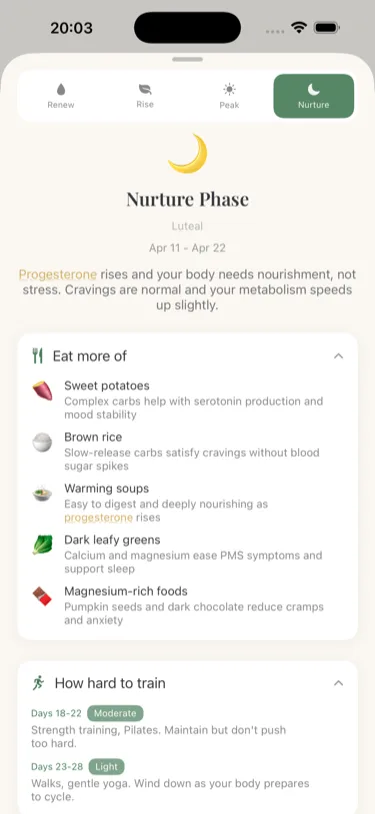
Fasting that adapts to your cycle
The app works out your cycle phase automatically and tells you what to eat, when to fast, and when to ease off, so your plan adjusts itself every week.

The best fix is usually earlier, not tougher
Most women do better when they shorten the fast before the late luteal week becomes a mess, rather than trying to rescue it once it has.
In practice that means:
- moving from 16:8 back to 12:12 or 13:11
- eating dinner earlier instead of eating less
- including complex carbohydrate at dinner to support sleep and steady energy
- reducing or removing fasted training
Timing is the point. Making these changes two or three days before your period, while you still feel reasonably steady, works far better than waiting until cravings and poor sleep have already taken over. This is the same pattern we work through in our luteal-phase guide, and it is one of the main reasons cycle-synced fasting tends to work better than a fixed schedule.
What not to do
The least helpful responses are usually some version of pushing harder:
- adding more caffeine to get through the morning
- skipping more food because the cravings feel alarming
- labelling yourself undisciplined
- trying to out-stubborn the phase
Each of those tends to lead to a harder evening, worse sleep, and a stronger urge to start over on Monday. The late luteal phase rarely responds well to force.
When this is normal and when it is a warning sign
It is normal for fasting to feel harder before your period, and on its own it is not a reason to worry.
It becomes a warning sign when the pattern is more extreme:
- you are regularly dizzy or lightheaded
- you binge at night after fasting all day
- your sleep is consistently wrecked, not just a little lighter
- your period changes substantially in timing or flow
- thoughts about food start to feel obsessive
At that point, the fix is a shorter window and, sometimes, a full pause, not a better fasting app or more motivation. A cycle that shifts noticeably after you start or intensify fasting is worth taking seriously rather than ignoring.
The simple rule
Before your period, protect the week.
Protect sleep, protect recovery, protect your mood. If you do that, fasting stays useful across the whole month instead of becoming something you can only tolerate for half of it.
For the broader framework, start with all guides or see how the app adapts phase by phase on the features page.
Frequently asked
- Why am I suddenly starving before my period even though fasting was easy last week?
- Because your hormone environment changed. In the late luteal phase, many women feel hungrier, sleep worse, and tolerate stress less well. The same fasting routine can therefore feel much harder.
- Does this mean fasting is not right for me?
- Not at all. It usually means the timing is wrong. A shorter window often works much better before your period.
- Should I stop fasting the week before my period?
- Some women do best with that. Others keep a light 12 to 13 hour overnight fast. What matters is whether the routine supports your mood, sleep, and recovery instead of making them worse.
- What is the best adjustment before your period?
- Shorten the fast early, eat enough at dinner, include complex carbs, and stop trying to copy your follicular-phase routine.
- Does fasting make PMS symptoms worse?
- It can, if the fasting window is too long for the late luteal phase. Long fasts in the days before your period often amplify cravings, broken sleep, and irritability. A shorter window, an earlier dinner, and enough complex carbohydrate usually ease those symptoms rather than adding to them.
References and further reading
- Intermittent Fasting in Female Reproduction: A Double-Edged Sword (Yang et al., Nutrition Reviews)
- Endocrine and chronobiological effects of fasting in women (Berga et al.)
- Exercise performance at different phases of the menstrual cycle (Wen et al., review)
- Menstruation and Menstrual Problems (NICHD)
FastingBestie app
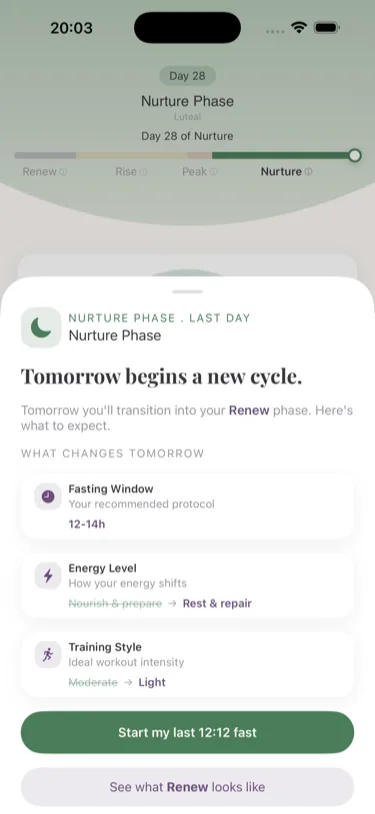
Skip the guesswork
FastingBestie reads your cycle phase and adjusts your fasting window, meals, and training as your hormones shift, so you always know today’s plan without rebuilding it.
FastingBestie provides evidence-informed guidance, not a substitute for professional medical advice. If you're pregnant, breastfeeding, have a history of disordered eating, or are managing a medical condition, talk to your doctor before starting or changing a fasting routine.