Foundations
Best Fasting Schedule for Women
The best fasting schedule for women is not the same every day. Here's a practical cycle-aware rhythm that keeps fasting useful without pushing it too far.
Educational content created by the FastingBestie team and maintained against the sources linked below. Research on cycle-synced fasting specifically is still emerging, so these guides combine direct evidence with broader fasting and menstrual-health literature. Read our editorial policy.
The best fasting schedule for women is usually not one fixed protocol repeated every day. Most women do better with a shorter baseline window, then longer or shorter fasting depending on where they are in the month.
If you have been told that the answer is simply “do 16:8 forever,” that is too blunt. Women’s physiology changes across the cycle, and the schedule that feels easy in week two can feel awful in week four. You can see the broader why in our guide to intermittent fasting for women. And if a simple weekly structure appeals more than a daily window, our review of The Fast Diet covers the 5:2 approach that made that style popular.
The best fasting window for women
A fasting window and a fasting schedule are two different things. The window is the number of hours you fast each day. The schedule is how that window changes across the week and the month.
For most women, the best fasting window is a 12 to 14 hour overnight fast as a baseline. From there, the window can stretch to 14 to 16 hours in the follicular phase and pull back during your period and the late luteal week. The rest of this guide turns that single window into a full cycle-aware schedule.
The best base schedule for most women
For most women, the most reliable foundation is a 12 to 14 hour overnight fast.
That usually means:
- dinner around 6:30 to 8:00pm
- first meal around 7:30 to 10:00am
- no need for heroic willpower
- enough room for breakfast when your body genuinely wants it
This is boring advice, which is one reason it works. It leaves enough room for protein, enough room for social life, and enough room to shorten the fast when your cycle or stress level says you should.
The schedule that tends to work across the month
Here is a practical rhythm.
| Phase | Suggested window | Why it works |
|---|---|---|
| Menstrual | 12 to 14 hours | Lower energy, more need for recovery |
| Follicular | 14 to 16 hours | Rising estrogen often makes fasting easier |
| Ovulatory | 13 to 15 hours | Strong phase, but social and training demands can vary |
| Luteal | 12 to 14 hours | Appetite and sleep often make long fasts less useful |
That is the same logic behind our complete guide to cycle-synced fasting. The exact number matters less than the direction: longer when the phase supports it, shorter when it does not.
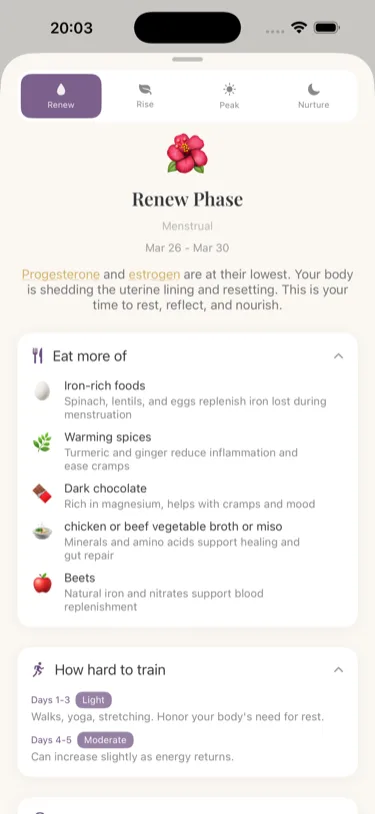
FastingBestie app
Fasting that adapts to your cycle
The app works out your cycle phase automatically and tells you what to eat, when to fast, and when to ease off, so your plan adjusts itself every week.

When a longer schedule makes sense
A longer schedule such as 15:9 or 16:8 can make sense if:
- you are eating enough protein and total food
- your period is stable
- you sleep well
- you are not deep in the late luteal week
- fasting feels easier, not harder, over time
For most women, that is not an all-month condition. It is more often a follicular-phase condition.
When the schedule is too aggressive
The best fasting schedule for women is one you can repeat without collateral damage. If you notice any of the following, the schedule is probably too aggressive:
- your period gets lighter, later, or disappears
- your sleep gets worse
- you become fixated on food
- you keep breaking the fast at night and feeling guilty
- your workouts feel flat for more than a few days
That does not mean fasting is wrong for you. It means the dose is wrong. Read our guides hub as a menu, not a set of rules you failed to follow.
How to choose the right schedule for your goal
If your goal is weight loss, the best schedule is usually the one that helps you eat sanely, not the one with the longest fasting window. A 13-hour overnight fast with good protein intake often beats a 16-hour fast followed by chaotic late-night snacking.
If your goal is energy and hormone stability, stay conservative. Use fasting to create meal structure, not deprivation.
If your goal is simplicity, keep the same meal times most days and only extend in the phases that tolerate it well.
What FastingBestie does differently
FastingBestie does not assume one static fasting plan. It changes guidance by phase, then adjusts food and training recommendations around that. If you want the practical version rather than the spreadsheet version, see how the app works or start with the science behind the method.
The best fasting schedule for women is the one that fits a female body as it actually behaves: cyclical, adaptive, and not identical every week.
Frequently asked
- What is the best fasting schedule for women starting out?
- For most beginners, 12 to 13 hours overnight is the best starting point. It is easy to recover from, easy to repeat, and much less likely to disrupt sleep or appetite than jumping straight into 16:8.
- Should women fast every day?
- Not necessarily. Some women like a light overnight window daily and only extend it in the follicular phase. Others fast five days a week and ease off during their period or late luteal days. Consistency matters, but rigidity is not required.
- Is 16:8 the best fasting schedule for women?
- It can work in the right phase, especially follicular, but it is not automatically the best option. Many women do better with a shorter baseline window and only use 16:8 selectively.
- What is the best fasting window for women?
- For most women, the best fasting window is 12 to 14 hours overnight as a baseline, extended to 14 to 16 hours in the follicular phase and kept shorter during your period and the late luteal week. A single fixed window all month works less well than one that flexes with your cycle.
- What if the schedule works for weight loss but my period changes?
- Your cycle wins that argument. If a fasting schedule changes your period, worsens sleep, or triggers binge-restrict patterns, it is too aggressive for you right now.
References and further reading
- Intermittent Fasting in Female Reproduction: A Double-Edged Sword (Yang et al., Nutrition Reviews)
- Effects of Intermittent Fasting on Health, Aging, and Disease (de Cabo & Mattson, NEJM review)
- Intermittent and periodic fasting, longevity and disease (Longo et al., Nature Aging review)
- The Menstrual Cycle: Menstruation, Ovulation, and How Pregnancy Occurs (ACOG)
- Endocrine and chronobiological effects of fasting in women (Berga et al.)
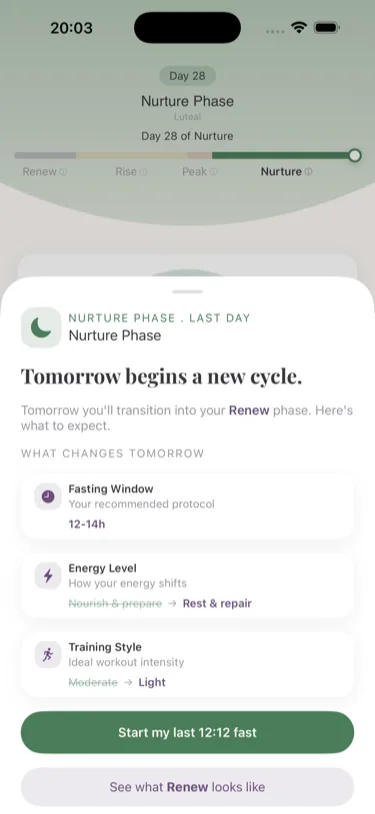
FastingBestie app
Skip the guesswork
FastingBestie reads your cycle phase and adjusts your fasting window, meals, and training as your hormones shift, so you always know today’s plan without rebuilding it.
FastingBestie provides evidence-informed guidance, not a substitute for professional medical advice. If you're pregnant, breastfeeding, have a history of disordered eating, or are managing a medical condition, talk to your doctor before starting or changing a fasting routine.