Foundations
Cycle Syncing Your Diet: What to Eat in Each Phase
Cycle syncing your diet, or cycle-based eating, means changing what you eat across your menstrual cycle: a practical phase-by-phase guide.
Educational content created by the FastingBestie team and maintained against the sources linked below. Research on cycle-synced fasting specifically is still emerging, so these guides combine direct evidence with broader fasting and menstrual-health literature. Read our editorial policy.
Cycle syncing your diet means adjusting what you eat across the four phases of your menstrual cycle, instead of eating the same way every day of the month. Your hormones shift week to week, your energy and appetite shift with them, and your food can follow that pattern rather than ignore it. You may also see this called cycle-based eating or a phase diet; they all describe the same approach.
This guide covers what to prioritise in each phase, and how cycle syncing your diet fits alongside cycle-aware fasting.
Cycle-based eating and phase diets
Cycle-based eating and a phase diet are other names for cycle syncing your diet: matching what you eat to the phase of your menstrual cycle instead of eating the same way every day. The food shifts are the same ones this guide covers, with more iron and steady meals during your period, ordinary balanced eating through the follicular and ovulatory phases, and more complex carbohydrate in the luteal phase.
Why food should shift across your cycle
Across a roughly 28-day cycle, estrogen and progesterone rise and fall in a predictable pattern. Those shifts change how hungry you feel, how your body handles carbohydrate, how well you sleep, and how much rest or activity you want.
Eating one fixed diet every day works against that rhythm, in the same way a fixed fasting schedule does. The week your body is asking for more food and more carbohydrate is not the week to cut hardest. Cycle syncing your diet is the food side of the approach behind cycle-synced fasting: work with the phase you are in, not against it. Dr Mindy Pelz’s book popularised this food-by-phase idea with its “hormone feasting” recipes; our review of Fast Like a Girl weighs how much of it to trust.
One note before the detail. This is general guidance for healthy adults, not a treatment plan. If you have a medical condition, are pregnant or breastfeeding, or have a history of disordered eating, talk to your doctor or a registered dietitian first.
What to eat in the menstrual phase
During your period, your body is shedding the uterine lining and losing blood, which also means losing iron. Energy is often at its lowest point of the month.
Priorities for this phase:
- iron-rich foods, such as red meat, liver, lentils, beans, and leafy greens
- protein at each meal to support steady energy
- warm, cooked meals rather than cold, raw ones, which many women find more comfortable
- enough carbohydrate to feel normal
This is a week to nourish rather than restrict. For the fasting side of the same phase, see Fasting During Your Period.
What to eat in the follicular phase
After your period ends, estrogen climbs and energy usually rises with it. Appetite is often steadier here, and food feels easier to manage.
This is a good phase for:
- plenty of protein to match rising energy and any harder training
- whole, minimally processed foods
- fresh vegetables and fruit, which often appeal more in this phase
There is no need to overhaul anything. The follicular phase is simply the part of the month when balanced, ordinary eating tends to feel most effortless, so it is a sensible time to build steady habits.
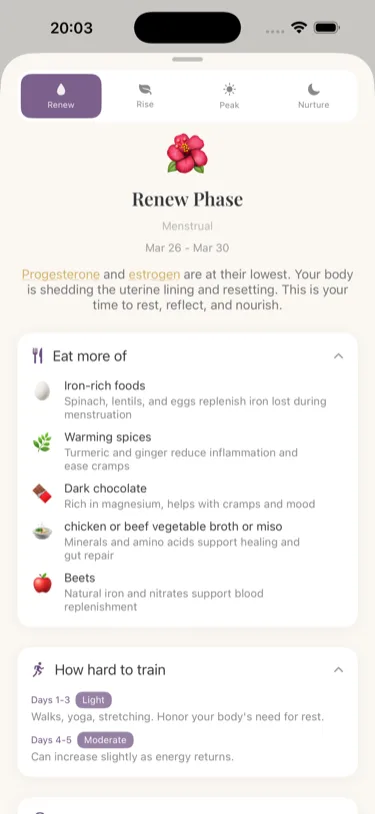
FastingBestie app
Fasting that adapts to your cycle
The app works out your cycle phase automatically and tells you what to eat, when to fast, and when to ease off, so your plan adjusts itself every week.

What to eat in the ovulatory phase
Around ovulation, estrogen peaks and many women feel their best. Training is often harder and social eating more frequent.
Helpful priorities:
- enough carbohydrate to fuel the workouts you actually do
- fibre-rich vegetables and fruit
- steady hydration, which matters more in this phase than many women expect
Ovulation is short, so the main job is to fuel your activity and keep meals reasonably consistent rather than chase a perfect plan.
What to eat in the luteal phase
In the luteal phase, progesterone rises, and in the days before your period both hormones drop. Appetite usually increases, cravings for carbohydrate and sugar are common, and sleep can become lighter.
This is the phase where food matters most:
- complex carbohydrates, such as oats, whole grains, and starchy vegetables, to support sleep and steady mood
- magnesium-rich foods, such as pumpkin seeds, nuts, and dark chocolate
- protein at every meal to keep hunger manageable
- enough food overall
The common mistake is treating luteal cravings as a discipline problem and eating less. Your body genuinely needs more here, and meeting that with nourishing choices works better than fighting it. The same logic applies to fasting in this phase, covered in Fasting During the Luteal Phase.
How cycle syncing your diet works with fasting
Cycle syncing your diet and cycle-synced fasting are two halves of one approach. Fasting decides when you eat. Cycle syncing your diet decides what you eat. Both should ease off during your period and the late luteal week, and both can allow more room in the follicular phase.
A few principles tie them together:
- never use fasting to skip the food a phase genuinely needs, especially iron in your period week and carbohydrate in your luteal week
- match your bigger meals to your higher-energy, higher-training days
- treat strong cravings and poor sleep as signals to add support, not remove it
The hormonal background to all of this is on the science page, and you can browse the full library at all guides.
The simple version
You do not need a different diet every day. You need to remember that two weeks of your cycle ask for more care and more food, and two weeks tend to feel easier.
Eat enough iron during your period, enough carbohydrate in the week before it, and ordinary balanced meals in between. Paired with a fasting window that follows the same pattern, that is most of what cycle syncing your diet looks like in practice.
Frequently asked
- What is a cycle syncing diet?
- Cycle syncing your diet means adjusting what you eat across your menstrual cycle. You prioritise iron and steady meals during your period, ordinary balanced eating in the follicular and ovulatory phases, and more complex carbohydrate and magnesium-rich food in the luteal phase.
- Is cycle-based eating the same as cycle syncing your diet?
- Yes. Cycle-based eating and cycle syncing your diet are two names for the same idea: matching your food to the phase of your menstrual cycle instead of eating the same way every day. Some people also call it a phase diet or phase-based eating.
- Does cycle syncing your diet help with weight loss?
- It can help indirectly, by making eating more consistent and reducing the under-eat then over-eat pattern many women fall into. It is not a weight-loss method on its own, and total food quality, protein, sleep, and activity still matter most.
- Can I cycle sync my diet without fasting?
- Yes. The food side works on its own. Many women use it alongside cycle-aware fasting, but you can adjust what you eat by phase whether or not you fast.
- What should I eat the week before my period?
- Focus on complex carbohydrates, magnesium-rich foods such as pumpkin seeds and nuts, and protein at every meal. The luteal phase usually needs more food, not less, and eating enough tends to ease cravings and support sleep.
References and further reading
- The Menstrual Cycle: Menstruation, Ovulation, and How Pregnancy Occurs (ACOG)
- Menstruation and Menstrual Problems (NICHD)
- Iron Fact Sheet for Consumers (NIH Office of Dietary Supplements)
- Intermittent Fasting in Female Reproduction: A Double-Edged Sword (Yang et al., Nutrition Reviews)
- Effects of Intermittent Fasting on Health, Aging, and Disease (de Cabo & Mattson, NEJM review)
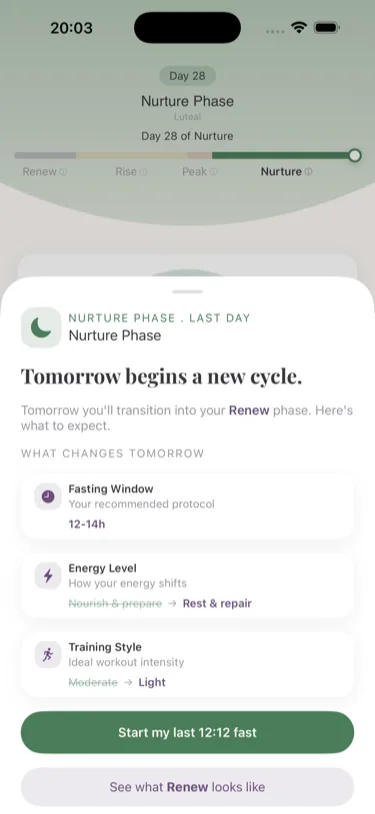
FastingBestie app
Skip the guesswork
FastingBestie reads your cycle phase and adjusts your fasting window, meals, and training as your hormones shift, so you always know today’s plan without rebuilding it.
FastingBestie provides evidence-informed guidance, not a substitute for professional medical advice. If you're pregnant, breastfeeding, have a history of disordered eating, or are managing a medical condition, talk to your doctor before starting or changing a fasting routine.