Foundations
Intermittent Fasting by Cycle Phase
How fasting should change across each phase of your cycle, from your period to the late luteal week, with practical windows that fit women's hormones.
Educational content created by the FastingBestie team and maintained against the sources linked below. Research on cycle-synced fasting specifically is still emerging, so these guides combine direct evidence with broader fasting and menstrual-health literature. Read our editorial policy.
Intermittent fasting by cycle phase means your fasting window changes across the month instead of staying fixed every day. For most women, that looks like gentler fasting during your period and luteal phase, longer windows in the follicular phase, and a more flexible approach around ovulation.
If you want the long version, start with our complete guide to cycle-synced fasting or the deeper physiology on the science page. This article is the condensed, practical version.
The phase-by-phase overview
Here is the short version of how intermittent fasting by cycle phase usually works.
| Phase | Typical days | Fasting window | What matters most |
|---|---|---|---|
| Menstrual | 1 to 5 | 12 to 14 hours, or none | Recovery, iron, warmth, sleep |
| Follicular | 6 to 13 | 14 to 18 hours | Longer windows, harder training, lighter appetite |
| Ovulatory | 14 to 17 | 13 to 15 hours | Flexibility, hydration, social meals |
| Luteal | 18 to 28 | 12 to 14 hours | Earlier meals, more carbs, less stress |
Those day ranges assume a 28-day cycle. If your cycle is shorter, longer, or unpredictable, the pattern still applies. What changes is the timing.
Menstrual phase: keep the fast light
During your period, estrogen and progesterone are low and blood loss can leave you tired, so a hard fast feels harder than usual. A 12-hour overnight window is enough for most women, and skipping the fast for the first day or two to focus on iron-rich meals, protein, and fluids is reasonable. Our guide to fasting during your period covers this week in more detail.
Follicular phase: this is the easiest time to extend
After bleeding ends, estrogen climbs and energy, training tolerance, and insulin sensitivity often rise with it. This is the phase where a 14 to 16 hour window usually feels easiest, and some women stretch to 17 or 18 hours without much friction. It is also the best place to test fasted training, carefully rather than every day.
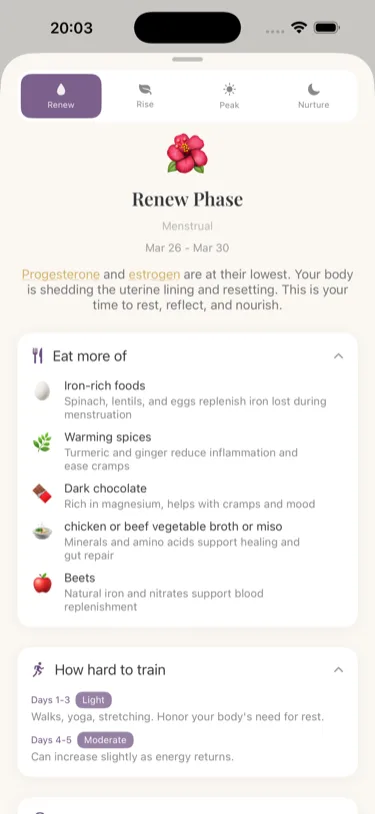
FastingBestie app
Fasting that adapts to your cycle
The app works out your cycle phase automatically and tells you what to eat, when to fast, and when to ease off, so your plan adjusts itself every week.

Ovulatory phase: stay flexible
Ovulation is often a strong phase, but not one for rigid scheduling. You may feel social, train hard, or notice your appetite swing from one day to the next, so a flexible 13 to 15 hour window usually works better than forcing a strict 16:8. Hydration matters here too: if you are training hard or sweating more, do not use fasting as a reason to underfuel. See fasting during ovulation for the detail on this phase.
Luteal phase: shorten the window before it starts fighting back
The luteal phase is where generic fasting advice tends to break down. Progesterone rises, sleep often gets lighter, appetite increases, and insulin sensitivity usually drops, so the long fast that felt easy in week two can leave you ravenous, wired, or flat. A 12 to 14 hour window, earlier dinners, and enough complex carbohydrate usually work better than chasing one more fasted hour. Our guide to fasting during the luteal phase goes deeper on this week.
What if your cycle is not a perfect 28 days?
Cycle-based fasting is still useful even if your timing shifts. You are not trying to hit exact dates. You are trying to respond to the pattern your body is giving you.
Look for cues:
- Bleeding, cramping, and lower energy usually mean menstrual-style fasting.
- Rising energy and easier workouts usually mean follicular-style fasting.
- Peak energy and more social appetite usually fit ovulation.
- Cravings, bloating, sleep changes, and premenstrual mood shifts usually mean luteal-style fasting.
If your cycle is very inconsistent, read our guides hub first, then use the gentler end of every range until you know your pattern.
How FastingBestie handles this
The FastingBestie app removes the need to remember all of this. It works out your cycle phase, then changes your fasting, food, and training guidance to match. If you want the product version of this method, see how the app works.
If you want the simple takeaway, it is this: intermittent fasting by cycle phase works because the same body does not have the same needs every week.
Frequently asked
- What does intermittent fasting by cycle phase actually mean?
- It means you stop using one fasting window all month. Instead, you shorten the fast when your body is under more hormonal or physical load, and lengthen it when energy, insulin sensitivity, and recovery are stronger.
- Which phase is best for longer fasts?
- For most women, the follicular phase is the easiest place to try a longer window. Estrogen is rising, energy is steadier, and appetite is often lower than it is later in the cycle.
- Should I do 16:8 in every phase?
- Usually no. Some women tolerate 16:8 well in the follicular phase, but the same schedule can feel much harder during menstruation or the late luteal phase. A cycle-aware approach works better than forcing the same protocol every week.
- Can I use this approach if my cycle is irregular?
- Yes. You may need to follow symptoms instead of dates. Rising energy, lighter appetite, and better workout tolerance often suggest a follicular-style phase, while cravings, worse sleep, and more bloating usually mean it is time to shorten the window.
References and further reading
- The Menstrual Cycle: Menstruation, Ovulation, and How Pregnancy Occurs (ACOG)
- Menstruation and Menstrual Problems (NICHD)
- Intermittent Fasting in Female Reproduction: A Double-Edged Sword (Yang et al., Nutrition Reviews)
- Exercise performance at different phases of the menstrual cycle (Wen et al., review)
- Effects of Intermittent Fasting on Health, Aging, and Disease (de Cabo & Mattson, NEJM review)
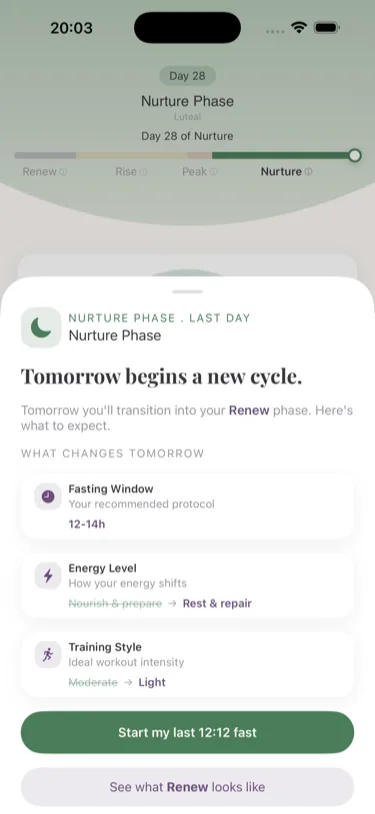
FastingBestie app
Skip the guesswork
FastingBestie reads your cycle phase and adjusts your fasting window, meals, and training as your hormones shift, so you always know today’s plan without rebuilding it.
FastingBestie provides evidence-informed guidance, not a substitute for professional medical advice. If you're pregnant, breastfeeding, have a history of disordered eating, or are managing a medical condition, talk to your doctor before starting or changing a fasting routine.