Follicular phase
Fasting in the Follicular Phase
The follicular phase is often the easiest time for women to fast. Here's how to use that window well without pushing too hard.
Educational content created by the FastingBestie team and maintained against the sources linked below. Research on cycle-synced fasting specifically is still emerging, so these guides combine direct evidence with broader fasting and menstrual-health literature. Read our editorial policy.
Fasting in the follicular phase is usually easier than fasting in the rest of the cycle. For many women, this is the best time to try a longer window because energy, insulin sensitivity, and training tolerance are often all moving in your favor.
That does not mean “go as hard as possible.” It means this is the phase where a longer fast is most likely to feel supportive instead of punishing.
Why the follicular phase often feels easier
The follicular phase begins after your period ends and runs until ovulation. Estrogen rises through this phase, and many women notice the same pattern:
- energy starts to come back
- appetite feels calmer
- workouts feel stronger
- recovery is better
This is one reason generic fasting advice sometimes seems to work for a while. A lot of it was effectively written for a follicular-phase body.
The best fasting window in the follicular phase
Most women do well somewhere between 14 and 18 hours in this phase. Where you sit inside that range depends on experience, stress, training, and how well you are eating.
If you are newer to fasting, 14 hours is enough.
If you already handle shorter windows well, 15:9 or 16:8 may fit nicely here. Some women extend beyond that late in the phase, but it is smarter to think of that as optional, not as the goal.
What to eat when fasting in the follicular phase
This is still a feeding phase, not just a fasting phase.
Make the eating window count:
- protein at every meal
- fiber-rich carbs
- plenty of fluids
- enough total calories to support training
The fact that fasting feels easy here can trick women into under-eating. That is where a good phase becomes a bad month.
FastingBestie app
Fasting that adapts to your cycle
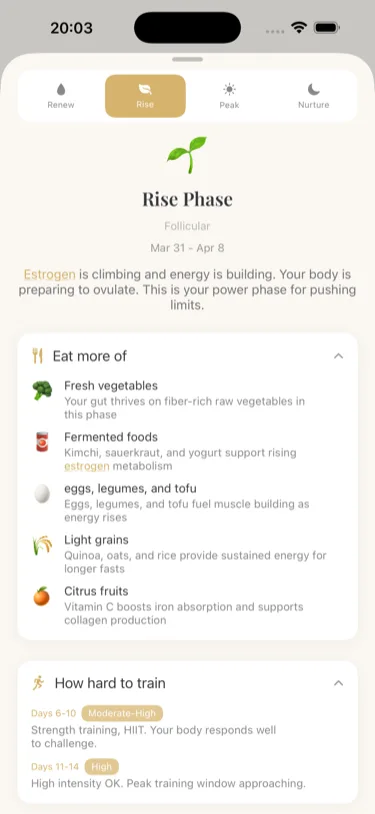
The app works out your cycle phase automatically and tells you what to eat, when to fast, and when to ease off, so your plan adjusts itself every week.

Training and the follicular phase
The follicular phase is often the best time for intensity. Strength training, intervals, and heavier sessions tend to fit better here than they do later in the cycle.
That said, fasted training is not automatically better training. If performance matters, or if you train for a long time, eating first can still be the smarter choice. The phase gives you more room to experiment. It does not remove the need to recover.
If you want the bigger cycle picture, our complete guide shows how this phase fits with the rest of the month.
The mistake to avoid
The biggest follicular-phase mistake is deciding that because a long fast feels easy now, it should become your permanent standard.
That usually backfires in the luteal phase.
Use this phase to take advantage of what is working. Do not use it to set expectations your body will not want to meet in two weeks.
How to know you are leaving the phase
If a window that felt easy suddenly feels awkward, social plans pick up, or your body wants a little more flexibility, you may be moving into ovulation. If appetite rises, sleep softens, or cravings increase, you may already be heading into the luteal phase.
That is the signal to adapt, not to push harder.
For the full library of phase guides, start at all guides. For the product version that does the phase-switching for you, see how the app works.
Frequently asked
- Is the follicular phase the best time to fast?
- For many women, yes. It is often the easiest phase for longer fasting windows because energy and insulin sensitivity are generally higher than they are later in the cycle.
- Can I do 16:8 in the follicular phase?
- Often yes, if you are already tolerating shorter fasts well. The follicular phase is usually the best place to test 16:8, but you still need enough food, protein, and sleep.
- Should I train fasted in the follicular phase?
- Some women feel good doing that here, especially with lower-intensity training or shorter sessions. Hard sessions still need honest fueling and recovery.
- When does the follicular phase end?
- It starts after menstruation and ends at ovulation. In a 28-day cycle, that is often around days 6 to 13, but your own cycle may be shorter or longer.
References and further reading
- The Menstrual Cycle: Menstruation, Ovulation, and How Pregnancy Occurs (ACOG)
- Menstruation and Menstrual Problems (NICHD)
- Intermittent Fasting in Female Reproduction: A Double-Edged Sword (Yang et al., Nutrition Reviews)
- Exercise performance at different phases of the menstrual cycle (Wen et al., review)
- Effects of Intermittent Fasting on Health, Aging, and Disease (de Cabo & Mattson, NEJM review)
FastingBestie app
Skip the guesswork
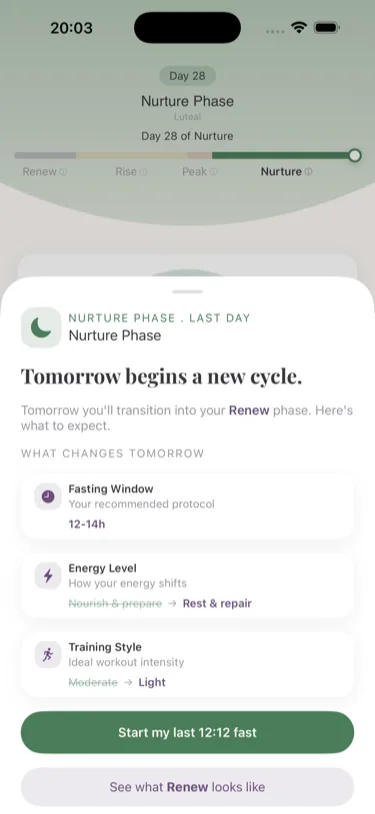
FastingBestie reads your cycle phase and adjusts your fasting window, meals, and training as your hormones shift, so you always know today’s plan without rebuilding it.
FastingBestie provides evidence-informed guidance, not a substitute for professional medical advice. If you're pregnant, breastfeeding, have a history of disordered eating, or are managing a medical condition, talk to your doctor before starting or changing a fasting routine.