Foundations
Intermittent Fasting for PCOS
Intermittent fasting for PCOS can help some women, but more is not better. The evidence, the limits, and the safer way to approach it.
Educational content created by the FastingBestie team and maintained against the sources linked below. Research on cycle-synced fasting specifically is still emerging, so these guides combine direct evidence with broader fasting and menstrual-health literature. Read our editorial policy.
Intermittent fasting for PCOS can help some women, but it is not automatically better than other nutrition strategies and it is definitely not a cure. The safest way to think about it is as one tool for structure and appetite control, not as a magic shortcut that overrides the rest of PCOS care.
That distinction matters because PCOS already changes the hormonal and metabolic picture before fasting even enters the conversation. Among fasting books, the one that gives PCOS real space is Megan Ramos’s; our review of Megan Ramos’s Essential Guide to Intermittent Fasting for Women covers the chapters devoted to it.
A note on the name. In May 2026, a global consensus published in The Lancet renamed PCOS to polyendocrine metabolic ovarian syndrome (PMOS). The new name reflects that the condition involves several hormonal and metabolic systems rather than the ovaries alone. The rollout runs over a three-year transition, so PCOS is still the term most women, doctors, and search engines use day to day. This guide uses PCOS throughout for that reason, and everything here applies equally under the PMOS label.
Why PCOS changes the fasting conversation
PCOS commonly overlaps with:
- irregular or absent periods
- insulin resistance
- weight gain or difficulty losing weight
- acne or hirsutism
- higher long-term cardiometabolic risk
Those features are part of why fasting gets so much attention in PCOS. Women want something practical that helps with appetite, blood sugar, and weight. That is a reasonable goal. It just needs a realistic frame.
What the evidence says right now
The current evidence is promising in places, but not strong enough to support exaggerated claims.
One 2024 randomized trial in women with PCOS compared 14:10 early time-restricted eating with a calorie-restricted control diet. All groups improved, but the fasting groups did not show clearly superior weight loss or better metabolic, menstrual, or gonadal outcomes over eight weeks.
That does not mean fasting is useless. It means we should be careful with the claim that PCOS requires fasting or that fasting is clearly better than every other structured approach.
The broader 2023 international PCOS guideline still puts the center of care where it belongs: lifestyle support, symptom management, individualized treatment, and attention to long-term metabolic health.
The safer way to do intermittent fasting for PCOS
For most women with PCOS, a gentler start works best:
- 12 to 14 hours overnight
- regular meal timing
- protein-forward meals
- enough fiber and carbs to avoid rebound eating
- strength training instead of endless punishment cardio
If that feels calm and sustainable, some women can extend slightly. But the goal is steady adherence, not the longest possible window.
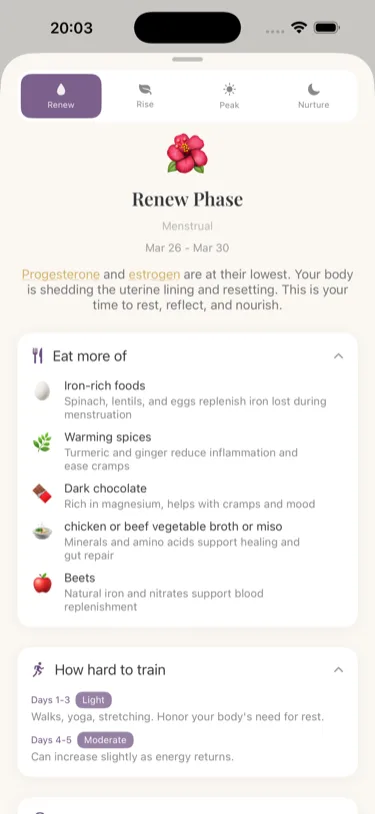
FastingBestie app
Fasting that adapts to your cycle
The app works out your cycle phase automatically and tells you what to eat, when to fast, and when to ease off, so your plan adjusts itself every week.

Should you cycle-sync if you have PCOS?
Usually yes, but with a caveat: the cycle may not be predictable enough to use dates alone.
Use symptoms:
- bleeding and lower energy suggest menstrual-style fasting
- better energy and easier workouts suggest follicular-style fasting
- cravings, worse sleep, and bloating suggest luteal-style fasting
If your cycle is irregular, our guide to fasting with an irregular cycle gives the broader logic. If you are newer to the topic, start with all guides.
Who should be extra careful
Be more cautious if:
- you are trying to conceive
- you take glucose-lowering medication
- you have a history of under-eating or disordered eating
- your periods become more irregular after starting fasting
This is not a place for bravado. PCOS is already variable enough.
The practical takeaway
Fasting with PCOS can be useful when it creates calm structure, not when it adds more physiological noise. If it helps you eat more consistently, manage appetite, and feel more stable, it may earn a place in the plan.
If it makes your cycle worse, your sleep worse, or your relationship with food worse, it is not the right dose.
Today, FastingBestie’s in-app guidance is built around cycle-aware fasting for women with a menstrual cycle. Dedicated PCOS-specific support is not live in the app yet, though it is on the roadmap. Until that lands, treat this guide as the more accurate reference point and use the app’s current recommendations with caution. You can still see the core product approach on the features page.
Frequently asked
- Is intermittent fasting good for women with PCOS?
- It can be helpful for some women, especially if it reduces chaotic eating and supports weight or appetite management. But it is not automatically better than other evidence-based nutrition approaches, and it should not be treated like a cure.
- Can fasting reverse PCOS?
- No. PCOS is a complex condition involving hormones, metabolism, and ovulation. Fasting may help some symptoms or metabolic markers in some women, but it does not reverse the condition.
- What fasting window is safest with PCOS?
- A gentle overnight window, often 12 to 14 hours, is a sensible place to start. Longer windows may work for some women, but the evidence does not support assuming that more fasting is always better.
- Should women with PCOS cycle-sync their fasting?
- Usually yes, as much as their cycle allows. If bleeding is irregular, use symptoms and recovery to guide the plan rather than forcing a perfect calendar.
- Has PCOS been renamed?
- Yes. In May 2026 a global consensus published in The Lancet renamed the condition polyendocrine metabolic ovarian syndrome (PMOS), reflecting that it involves several hormonal and metabolic systems, not only the ovaries. The change is rolling out over a three-year transition, so most people and search results still use PCOS for now. The fasting guidance here applies under either name.
References and further reading
- Polycystic Ovary Syndrome (PCOS) (ACOG)
- Polyendocrine Metabolic Ovarian Syndrome: New name to improve diagnosis and care (Endocrine Society, May 2026)
- Polycystic Ovary Syndrome (PCOS) (NICHD)
- Recommendations from the 2023 International Evidence-based Guideline for the Assessment and Management of Polycystic Ovary Syndrome
- Time-restricted eating versus calorie restriction in women with PCOS: randomized clinical trial (Talebi et al.)
- Intermittent Fasting in Female Reproduction: A Double-Edged Sword (Yang et al., Nutrition Reviews)
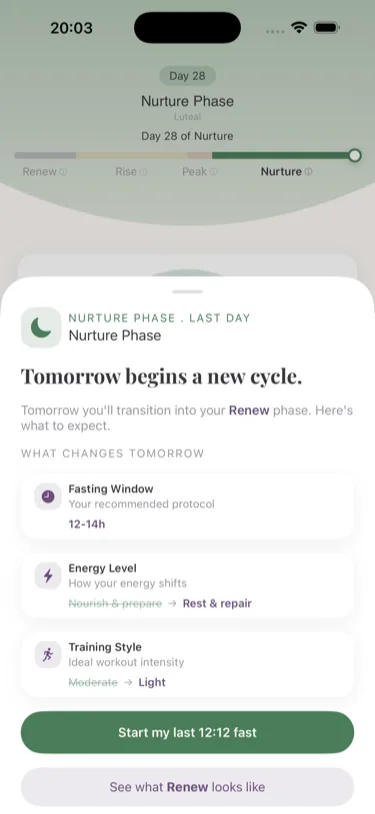
FastingBestie app
Skip the guesswork
FastingBestie reads your cycle phase and adjusts your fasting window, meals, and training as your hormones shift, so you always know today’s plan without rebuilding it.
FastingBestie provides evidence-informed guidance, not a substitute for professional medical advice. If you're pregnant, breastfeeding, have a history of disordered eating, or are managing a medical condition, talk to your doctor before starting or changing a fasting routine.