Foundations
Intermittent Fasting and Hormone Balance for Women
Can intermittent fasting balance your hormones? Where fasting supports women's hormones, where it can disrupt them, and how to fast more safely.
Educational content created by the FastingBestie team and maintained against the sources linked below. Research on cycle-synced fasting specifically is still emerging, so these guides combine direct evidence with broader fasting and menstrual-health literature. Read our editorial policy.
Intermittent fasting can affect women’s hormones, but “hormone balance” is a vague phrase, and fasting is not a way to fix a hormonal problem. Done carefully, it can support some of the systems behind steady energy and metabolism. Done too aggressively, it can disrupt the reproductive hormones that drive your menstrual cycle.
This guide explains where fasting and hormone balance genuinely connect, where they do not, and how to fast in a way that supports your hormones instead of fighting them.
What “hormone balance” actually means
“Hormone balance” is a wellness phrase rather than a medical diagnosis. Your hormones are not meant to sit at fixed levels. Estrogen and progesterone rise and fall across your cycle, and that movement is the whole point of a healthy cycle.
A more useful question is whether fasting supports your hormonal systems working well or interferes with them. It can do either, and which it does depends on the dose and the timing.
How fasting can support women’s hormones
The clearest evidence for intermittent fasting sits with metabolic health. Reviews of intermittent fasting describe improvements in insulin sensitivity and blood sugar regulation for many people, alongside other metabolic markers.
Insulin is a hormone, and steadier blood sugar matters for women whose symptoms are linked to insulin resistance. That is part of why fasting is sometimes discussed in the context of conditions such as PCOS, covered in detail in our guide to intermittent fasting for PCOS.
A gentle, consistent fasting routine can also bring structure to eating, which indirectly supports sleep and steadier energy. Those are modest effects rather than dramatic hormonal changes, but they are real and worth having.
How fasting can disrupt women’s hormones
The other edge matters just as much. Research on intermittent fasting in female reproduction describes it as a double-edged influence: useful in some respects, but capable of disrupting reproductive hormones when it is too aggressive.
Fasting is a mild stressor. Long fasts, very low food intake, heavy training, and high life stress can stack together, and the body can respond by down-regulating reproductive hormones. In practice that can show up as later ovulation, a lighter or missed period, or a cycle that becomes harder to predict.
Your menstrual cycle is a useful gauge here. A cycle that changes noticeably after you start or intensify fasting is information worth acting on. The when to stop fasting guide covers those warning signs in full.
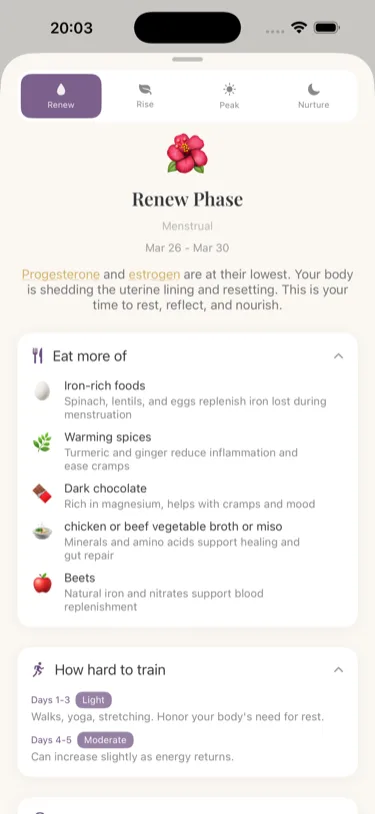
FastingBestie app
Fasting that adapts to your cycle
The app works out your cycle phase automatically and tells you what to eat, when to fast, and when to ease off, so your plan adjusts itself every week.

The cycle is the key variable
This is where fasting for women differs most from generic advice. The same fasting window does not carry the same hormonal cost every week.
In the follicular phase, when estrogen is rising, most women tolerate longer fasts well. During the luteal phase and your period, the same long fast asks more of a body that is already under more hormonal load. Fasting hard in those weeks is the most common way a reasonable habit starts to work against your hormones.
Matching the fasting window to your phase, rather than holding one schedule all month, is the single most useful adjustment. The full model is in our cycle-synced fasting guide, and the hormonal background is on the science page.
What matters more than the fasting window
If your goal is to feel hormonally steady, several things tend to matter more than how long you fast:
- eating enough total food, and enough protein
- sleeping well and consistently
- keeping training appropriate to the phase you are in
- managing stress, since cortisol interacts with the rest of your hormones
A modest fasting window sits on top of those foundations rather than replacing them. A long fast paired with poor sleep and under-eating is far more likely to disrupt your hormones than a shorter fast paired with good food and proper rest.
When to be cautious
Fasting is not the right tool for everyone, and it is not a treatment for a hormonal condition. Speak to a doctor before fasting, or before changing your routine, if:
- your periods are irregular, very heavy, or have stopped
- you are pregnant, breastfeeding, or trying to conceive
- you have a thyroid condition, PCOS, or another diagnosed hormonal condition
- you have a history of disordered eating
In those situations, individual medical advice matters more than any general fasting plan.
The honest takeaway
Intermittent fasting does not “balance” your hormones, and no fasting plan should be sold that way. What it can do, when it is gentle and matched to your cycle, is support steady blood sugar and a consistent routine without disrupting the reproductive hormones behind your cycle.
Fast in a way that protects your sleep, your cycle, and your energy, and fasting stays on the supportive side of that double edge. You can see how the FastingBestie app adjusts the window for you on the features page, or browse all guides.
Frequently asked
- Can intermittent fasting balance your hormones?
- Not in the way the phrase suggests. Hormones are meant to rise and fall across your cycle, not sit at fixed levels. Gentle fasting can support insulin sensitivity and a steady routine, but it is not a treatment that corrects a hormonal problem.
- Can fasting mess up your hormones?
- It can, if it is too aggressive. Long fasts combined with under-eating, heavy training, or high stress can disrupt reproductive hormones and change your menstrual cycle. A shorter, cycle-aware window is much less likely to do this.
- Does fasting affect estrogen and progesterone?
- It can, indirectly. Aggressive fasting can interfere with the signals that drive ovulation, which is what produces estrogen and progesterone in their normal pattern. Gentle fasting matched to your cycle is far less likely to interfere.
- Is fasting safe if I have a hormonal condition?
- Talk to your doctor first. Fasting is not a treatment for PCOS, thyroid conditions, or other hormonal conditions, and whether it is appropriate depends on your individual situation.
References and further reading
- Intermittent Fasting in Female Reproduction: A Double-Edged Sword (Yang et al., Nutrition Reviews)
- Endocrine and chronobiological effects of fasting in women (Berga et al., Fertility and Sterility)
- Effects of Intermittent Fasting on Health, Aging, and Disease (de Cabo & Mattson, NEJM review)
- Intermittent and periodic fasting, longevity and disease (Longo et al., Nature Aging review)
- The Menstrual Cycle: Menstruation, Ovulation, and How Pregnancy Occurs (ACOG)
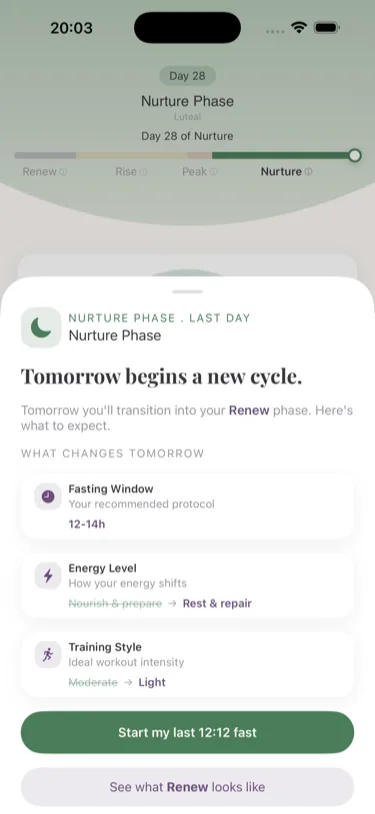
FastingBestie app
Skip the guesswork
FastingBestie reads your cycle phase and adjusts your fasting window, meals, and training as your hormones shift, so you always know today’s plan without rebuilding it.
FastingBestie provides evidence-informed guidance, not a substitute for professional medical advice. If you're pregnant, breastfeeding, have a history of disordered eating, or are managing a medical condition, talk to your doctor before starting or changing a fasting routine.