Foundations
Monthly Fasting Schedule for Your Cycle
A monthly fasting schedule for women works best as a 4-week calendar that follows your cycle. Here is when to extend your fast and when to ease off.
Educational content created by the FastingBestie team and maintained against the sources linked below. Research on cycle-synced fasting specifically is still emerging, so these guides combine direct evidence with broader fasting and menstrual-health literature. Read our editorial policy.
A monthly fasting schedule for women works best when it follows the rhythm of the menstrual cycle. Instead of repeating one window every day, you adjust the fast as hormones, appetite, training tolerance, and recovery shift from week to week.
This article gives you the calendar version of the method: a repeatable 4-week plan. For the reasoning behind it, read our complete guide to cycle-synced fasting, and for the general approach to windows, see the best fasting schedule for women.
The 4-week monthly fasting schedule
| Week of cycle | Typical phase | Fasting window | Main goal |
|---|---|---|---|
| Week 1 | Menstrual | 12 to 14 hours, or none | Recover and eat well |
| Week 2 | Follicular | 14 to 16 hours | Take advantage of rising energy |
| Week 3 | Ovulatory | 13 to 15 hours | Stay flexible around training and life |
| Week 4 | Luteal | 12 to 14 hours | Protect sleep, mood, and appetite |
That is the core pattern. Everything else is refinement.
Week 1: Menstrual
Your period is not the week to force a longer fast. Shorter overnight windows make more sense here, especially if bleeding is heavy, energy is low, or cramps are strong.
Think simple: eat warm meals, get enough iron and protein, and do not confuse discomfort with virtue. If you need the detailed playbook, fasting during your period goes deeper.
Week 2: Follicular
This is usually the easiest week for fasting. Estrogen is rising, many women feel lighter and more resilient, and a 14 to 16 hour window often feels natural instead of forced.
If you want to test a slightly longer window, this is the week to do it. It is also the week where harder training often fits best.
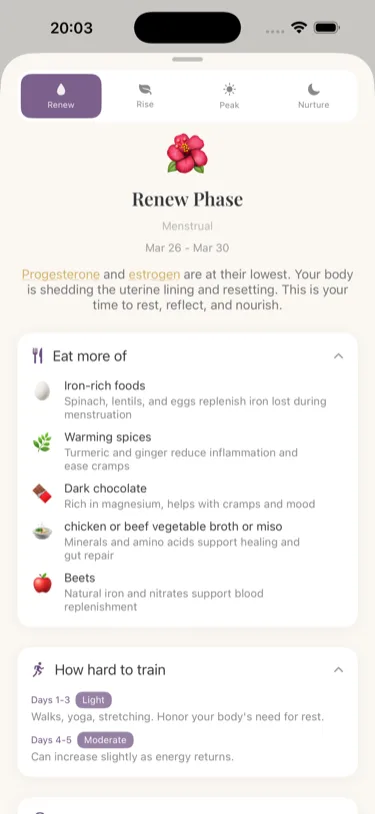
FastingBestie app
Fasting that adapts to your cycle
The app works out your cycle phase automatically and tells you what to eat, when to fast, and when to ease off, so your plan adjusts itself every week.

Week 3: Ovulatory
Ovulation is often a strong phase, but it can be unpredictable from a social and appetite perspective. Many women feel great. Many women also have more meals out, more intense workouts, or a bigger desire for flexibility.
That is why the monthly schedule usually softens slightly here. A 13 to 15 hour window keeps structure without forcing your week to revolve around the clock.
Week 4: Luteal
This is where the monthly schedule earns its keep. Appetite is usually higher, sleep can get worse, and rigid fasting often stops being useful.
The smart move is to shorten the fast before the week starts fighting back. Earlier dinners, more satisfying meals, and less fasted training are usually a better use of effort than trying to repeat your week-two protocol.
If your cycle is shorter, longer, or irregular
Use the schedule as a pattern, not a prison.
If your cycle is 24 days, the phases still exist, they just move faster. If your cycle is 33 days, the luteal phase may last longer. If your cycle is irregular, use the schedule by symptom:
- bleeding and lower energy suggest menstrual mode
- easier fasting and better workouts suggest follicular mode
- peak energy suggests ovulatory mode
- cravings and sleep changes suggest luteal mode
For more support, start with the full guides library or the product walkthrough on the features page.
The most useful part of a monthly fasting schedule
The value is not that it gives you a prettier calendar. The value is that it stops you from judging yourself against the wrong week.
Women often feel disciplined in the follicular phase and “bad at fasting” in the luteal phase, when really they are just experiencing normal hormone shifts. A monthly schedule gives those shifts somewhere to go.
Frequently asked
- What is the best monthly fasting schedule for women?
- A simple version is 12 to 14 hours during menstruation, 14 to 16 hours in the follicular phase, 13 to 15 hours around ovulation, and back to 12 to 14 hours in the luteal phase.
- Do I need a perfect 28-day cycle to use a monthly fasting schedule?
- No. The schedule is a template, not a law. If your cycle is shorter, longer, or irregular, use your symptoms and recent bleeding pattern to place yourself in the right phase.
- Can I just keep the same fasting window all month?
- You can, but many women feel better when they do not. The whole point of a monthly schedule is that the body is not asking for the same thing in every week.
- What should I do if the late luteal week feels much harder than the rest?
- Shorten the fast early rather than waiting until you feel wrecked. Earlier meals, enough carbs at dinner, and less fasted training usually help more than trying to push through.
References and further reading
- The Menstrual Cycle: Menstruation, Ovulation, and How Pregnancy Occurs (ACOG)
- Menstruation and Menstrual Problems (NICHD)
- Intermittent Fasting in Female Reproduction: A Double-Edged Sword (Yang et al., Nutrition Reviews)
- Exercise performance at different phases of the menstrual cycle (Wen et al., review)
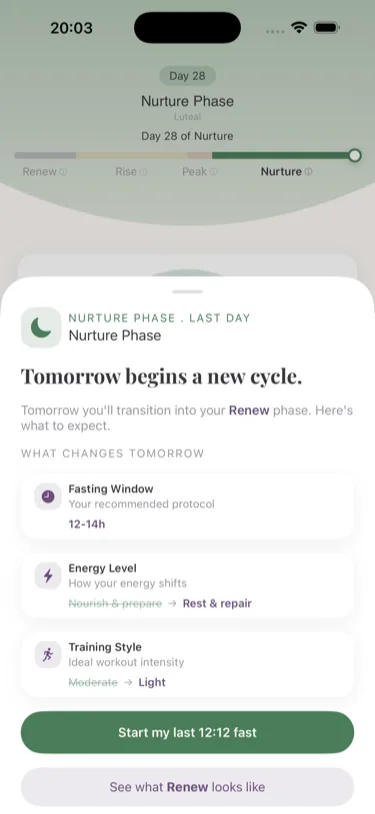
FastingBestie app
Skip the guesswork
FastingBestie reads your cycle phase and adjusts your fasting window, meals, and training as your hormones shift, so you always know today’s plan without rebuilding it.
FastingBestie provides evidence-informed guidance, not a substitute for professional medical advice. If you're pregnant, breastfeeding, have a history of disordered eating, or are managing a medical condition, talk to your doctor before starting or changing a fasting routine.