Foundations
16:8 Fasting for Women
16:8 fasting can work for women, but not usually every day of the month. Here's when it fits, when it backfires, and how to test it safely.
Educational content created by the FastingBestie team and maintained against the sources linked below. Research on cycle-synced fasting specifically is still emerging, so these guides combine direct evidence with broader fasting and menstrual-health literature. Read our editorial policy.
16:8 fasting can work for women, but it is not automatically the best plan for every day of the month. In practice, it usually works best when you use it selectively, most often in the follicular phase, instead of treating it like a year-round default.
That is the missing context in most 16:8 advice. The protocol is simple. Female physiology is not.
What 16:8 actually means
16:8 means fasting for 16 hours and eating within an 8-hour window. A common version is finishing dinner at 7pm and eating the first meal at 11am the next day.
That can be a useful structure. It can also be more aggressive than it sounds if you are already under-slept, stressed, training hard, or sitting in the late luteal part of your cycle.
When 16:8 tends to work best for women
For many women, 16:8 works best:
- after the period ends
- when energy is rising
- when appetite feels naturally lower
- when sleep is solid
- when meals inside the window are large enough and protein-rich
That usually means the follicular phase. If you want the phase-by-phase view, go to our full cycle-synced fasting guide.
When 16:8 tends to backfire
16:8 is much more likely to backfire:
- during the first heavy days of your period
- in the late luteal week before your period
- during periods of high stress
- if you use it together with hard fasted training
- if it becomes an excuse to under-eat all day and overeat at night
This is where a lot of women decide fasting “does not work for them” when the real issue is that 16:8 is being used at the wrong time.
FastingBestie app
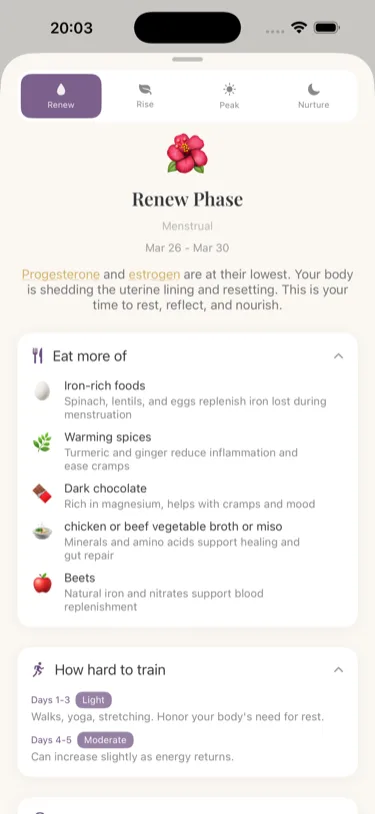
Fasting that adapts to your cycle
The app works out your cycle phase automatically and tells you what to eat, when to fast, and when to ease off, so your plan adjusts itself every week.

The better way to test it
Do not start with 16:8 every day. Build up from a 12 to 14 hour overnight fast first.
Then test 16:8:
- in the follicular phase
- for two or three days, not fourteen
- with enough protein at both meals
- with honest attention to sleep, mood, hunger, and cycle changes
If it feels calm and easy, you can keep it in that phase. If it creates rebound hunger or restless sleep, drop back to 14:10 or 13:11.
What women often get wrong about 16:8
The common mistake is focusing on the fasting window and ignoring the rest:
- too little protein
- too much caffeine while fasted
- long gaps before exercise and long gaps after it
- late-night eating because the whole day got compressed
- no change in routine when the luteal phase hits
The protocol only works if the rest of the day still makes physiological sense.
What to do during your period and luteal phase
Most women feel better shortening the window to 12 to 14 hours during menstruation and the luteal phase. That is not failure. It is what a female body often needs when hormones, appetite, and recovery all shift at once.
If you want the specific menstrual guidance, read our guide to fasting during your period. If you want the broader library, browse all guides.
A simple rule for 16:8 fasting for women
Use 16:8 when it feels supportive, not heroic.
If you are sleeping well, recovering well, and eating enough, it may be a useful option. If you are white-knuckling the last hours of the fast, snapping at everyone by afternoon, and raiding the kitchen at night, the answer is not to be stricter. The answer is to shorten the window.
FastingBestie builds that adjustment in automatically. The app changes the recommendation by phase so you do not have to keep negotiating with yourself. You can see that flow on the features page.
Frequently asked
- Is 16:8 fasting safe for women?
- For many healthy women, yes, but context matters. It is usually safer when you build up gradually, eat enough during the eating window, and avoid forcing it in the phases where your body is under more hormonal stress.
- When is 16:8 easiest for women?
- Usually in the follicular phase and sometimes early ovulation. Energy and insulin sensitivity are often better there than during the late luteal week.
- Should women do 16:8 every day?
- Usually no. Some women feel great on it for part of the month and worse on it later in the cycle. A flexible schedule tends to work better than trying to prove you can do the same thing every day.
- What if 16:8 helps me lose weight but I feel wired and hungry?
- That is a tradeoff worth taking seriously. A shorter fast that you can sustain calmly is usually better than a longer one that disrupts sleep, recovery, or your relationship with food.
References and further reading
- Effects of Intermittent Fasting on Health, Aging, and Disease (de Cabo & Mattson, NEJM review)
- Intermittent and periodic fasting, longevity and disease (Longo et al., Nature Aging review)
- Intermittent Fasting in Female Reproduction: A Double-Edged Sword (Yang et al., Nutrition Reviews)
- Endocrine and chronobiological effects of fasting in women (Berga et al.)
FastingBestie app
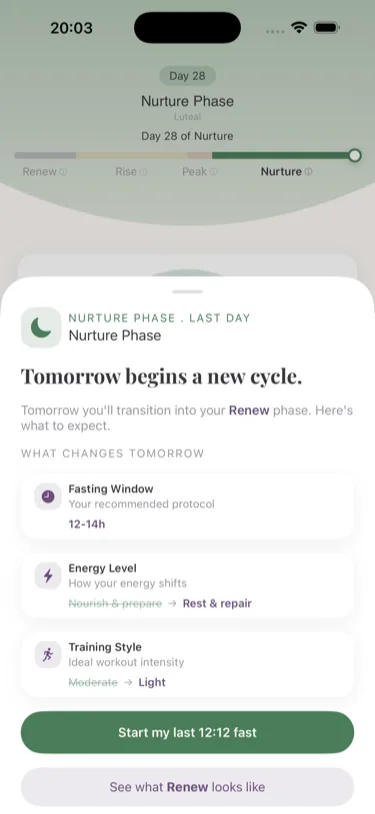
Skip the guesswork
FastingBestie reads your cycle phase and adjusts your fasting window, meals, and training as your hormones shift, so you always know today’s plan without rebuilding it.
FastingBestie provides evidence-informed guidance, not a substitute for professional medical advice. If you're pregnant, breastfeeding, have a history of disordered eating, or are managing a medical condition, talk to your doctor before starting or changing a fasting routine.